Accelerator Availability Reaches Equilibrium
Why Does This Exist?
For three years, the most valuable skill an ML engineer possessed was the ability to source H100 GPUs. Cloud providers were completely sold out, secondary markets were charging extortionate hourly rates, and startups were rationing compute just to keep inference endpoints alive.
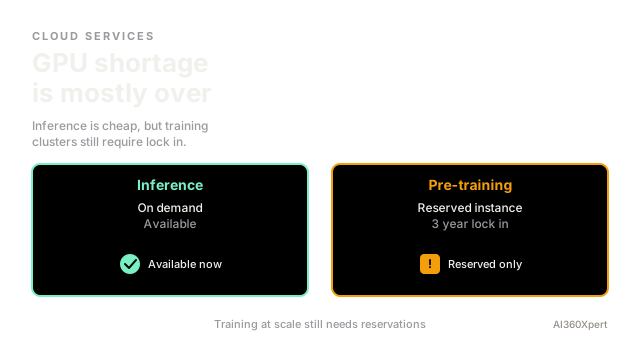
As of August 2026, the supply chain has caught up. The sheer volume of next-generation silicon hitting the data centers has finally saturated the mid-tier market. You no longer need to sign a three-year reserved instance contract just to spin up an inference node.
Think of It Like This
It is like the housing market after a massive construction boom. You can easily rent an apartment (inference compute) on short notice for a reasonable price. But if you want to buy a massive estate to build a factory (a large-scale training cluster), you still need to negotiate with the major landowners.
How It Actually Works
The equilibrium was reached due to three factors:
- Hardware Diversification: Cloud providers successfully pushed customers onto proprietary silicon (like AWS Trainium/Inferentia and Google TPUs) for standard workloads, relieving pressure on the flagship Nvidia SKUs.
- Inference Optimization: Techniques like continuous batching, aggressive quantization, and speculative decoding radically increased the number of tokens a single GPU could serve, decreasing the total hardware required to handle user traffic.
- Capacity Rollouts: The mega-clusters ordered in 2024 finally came online.
Today, spinning up a node for serving a 70B parameter model is a simple API call on almost any cloud. However, securing a contiguous block of 10,000 interconnect-optimized GPUs for a frontier model pre-training run still requires a heavy upfront financial commitment. The cloud providers won't dedicate that network topology without guaranteed revenue.
Watch Out For
Spot instance pricing for older generation hardware (like A100s) has plummeted, but they are often inefficient for modern architectures that rely heavily on FP8 math. Do not just look at the hourly rate; look at the cost per token processed. A more expensive, newer GPU is often cheaper in the long run.
(Correct as of August 2026).
The Quick Version
The critical shortage of cloud GPUs for inference has ended, driven by better software optimization and massive hardware rollouts. However, large-scale training clusters still require reserved instance commitments.