The EU AI Act's Article 50 Disclosure Rules Are Now Active
Why Does This Exist?
For years, it was perfectly legal to spin up a customer service chatbot and let users assume they were talking to a human. Companies did this because users drop off or lose trust when they realise a machine is answering their questions.
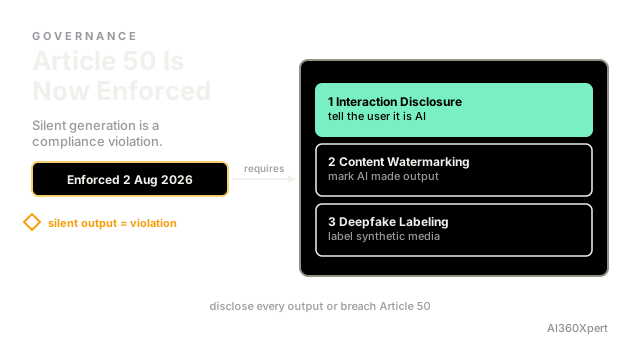
That grace period ended on August 2, 2026. The European Union's AI Act has officially activated the transparency obligations under Article 50. The core philosophy is simple: users have an absolute right to know when they are interacting with an AI system, and when content has been artificially generated or manipulated.
Think of It Like This
It is the digital equivalent of an ingredient label. Just as you are legally required to state if a food product contains peanuts, you are now legally required to state if a text, image, or video was generated by an AI. You cannot bury it in the terms of service; it must be stamped on the product.
How It Actually Works
Article 50 breaks down into a few mandatory technical requirements:
- Interaction Disclosure: If an AI system interacts directly with a natural person (e.g., a chatbot or voice agent), the system must explicitly disclose that it is an AI before the interaction begins. The only exception is if it's glaringly obvious from the context (like an NPC in a video game).
- Content Watermarking: If your system generates synthetic audio, image, video, or text content, that output must be marked in a machine-readable format and detectable as artificially generated or manipulated. This means metadata tagging and visible watermarking.
- Deepfake Labeling: If you generate a deepfake (an image, audio, or video that resembles existing persons or places and would falsely appear authentic to others), you must disclose that the content has been artificially generated or manipulated in a clear and visible manner.
If you are a provider or a deployer of an AI system serving users in the EU, and you fail to implement these mechanisms, you are subject to the Act's enforcement penalties. The grace period is over.
Watch Out For
Machine-readable watermarking for text is still an unsolved technical problem. While image metadata (like C2PA) is well-established, subtly altering the probability distribution of LLM tokens to embed a watermark often degrades output quality and is easily scrubbed by the user. If you are serving text, focus on explicit UI disclosures while the industry standardises text watermarks.
(Correct as of August 2026, following the EU AI Act's phased implementation schedule).
The Quick Version
Article 50 of the EU AI Act is now fully enforced. Any AI system interacting with EU citizens or generating synthetic media must explicitly disclose its nature and watermark its outputs. Silent generation is now a compliance violation.