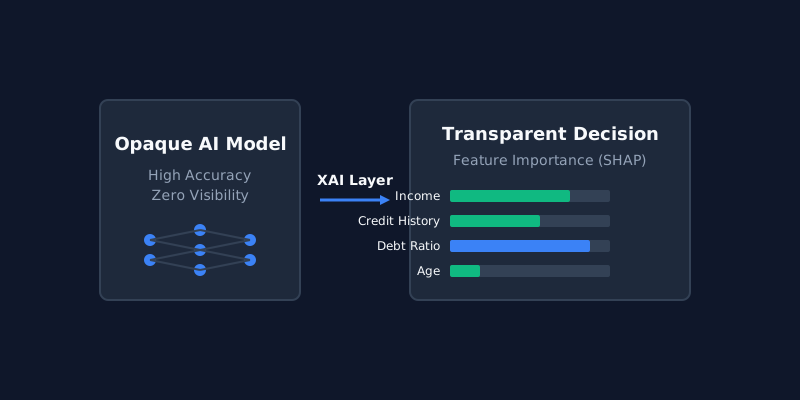
Black Boxes Belong in Airplanes: Why Explainable AI is Now a Compliance Baseline
The days of deploying an inscrutable neural network and hoping for the best are over. For years, machine learning teams accepted a fundamental trade-off: you can have accuracy, or you can have interpretability, but you can't have both. We tolerated "black box" models because they gave us better predictions.
But the landscape has fundamentally changed. The trade-off is no longer acceptable. Explainable AI (XAI) isn't just about ethics or debugging anymore; it's a non-negotiable compliance baseline.
The Regulatory Hammer
If you look at recent legislation, the writing is on the wall. The EU AI Act has established strict transparency requirements for high-risk AI systems. If your model determines creditworthiness, resume screening, or medical triaging, you must be able to explain why it made a specific decision.
This isn't a theoretical concern for 2030. As of September 2026, regulators are actively auditing production systems. If your risk team cannot trace a model's prediction back to its input features, you are exposed.
Interpretability vs. Explainability
It's crucial to distinguish between inherently interpretable models and post-hoc explainability techniques.
- Interpretable Models: These are transparent by design. Think linear regression or decision trees. You can trace the exact mathematical path.
- Post-Hoc Explainability: This involves slapping a tool on top of a black box. Techniques like SHAP (SHapley Additive exPlanations) or LIME try to approximate the local behavior of complex models like LLMs or deep neural networks.
While post-hoc tools are powerful, they are approximations. They tell you what features the model probably relied on, not what it definitely relied on. For the highest-stakes decisions, you might have to abandon deep learning entirely in favor of an interpretable model.
The Business Case for Transparency
Even if regulations didn't exist, opaque models are bad business.
When a model's logic is hidden, you can't trust its robustness. Is it truly generalizing, or has it memorized a spurious correlation in your training data? XAI provides a diagnostic lens. It helps engineering teams catch data leakage and bias before they hit production.
Furthermore, user trust is paramount. A doctor won't rely on an AI diagnostic tool that spits out a diagnosis without a rationale. A loan applicant deserves to know why they were rejected so they can improve their financial standing.
The End of the Black Box
The era of "it works, but we don't know why" is coming to a close. Engineering teams must treat explainability as a first-class metric, tracked right alongside F1 scores and latency. If you can't explain it, you shouldn't ship it.
(Correct as of September 2026).