Why Fine-Tuning LLMs on Your Own Data Beats Off-the-Shelf RAG
The AI industry has spent the last two years convincing everyone that Retrieval-Augmented Generation (RAG) is the only safe way to make a language model understand your business. But here is the truth: RAG is a band-aid. If you want a model that naturally speaks your domain's language without constantly fumbling through retrieved documents, you need to fine-tune.
And as of late 2026, full fine-tuning or using LoRA on your own data is no longer a research project—it is cheaper, faster, and more reliable than maintaining a brittle retrieval pipeline.
The Hidden Cost of RAG Pipelines
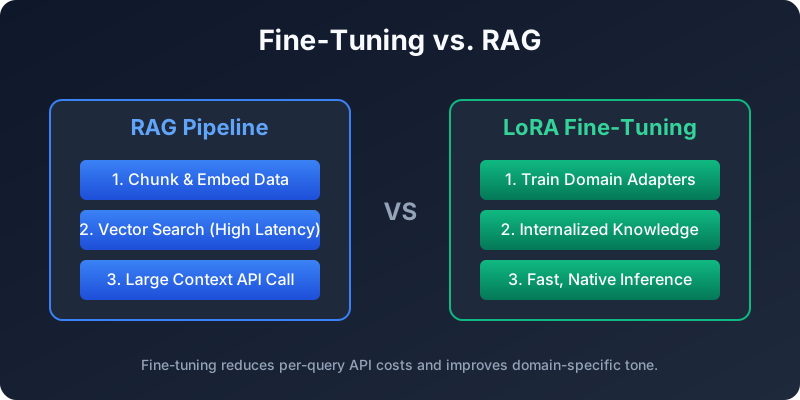
RAG looks simple on paper: chunk your data, embed it, stuff it into a vector database, and retrieve it when the user asks a question. But in practice, you end up wrestling with chunk sizes, retrieval latency, and models that hallucinate when they get conflicting context. Every cloud provider wants to sell you a managed RAG service because they can charge you for the vector storage, the embedding API, and the inference API on every single query.
Fine-Tuning is Now a Commodity
Instead of paying a cloud provider a premium for a managed retrieval service, you can now rent a single cloud GPU for a few dollars an hour and run a Supervised Fine-Tuning job. Techniques like LoRA (Low-Rank Adaptation) allow you to adapt an open-weight model like Llama 3 or Mistral to your specific data without retraining the entire network.
When you fine-tune, the model internalizes the tone, the terminology, and the implicit knowledge of your domain. It doesn't need to read a retrieved manual to know how your company talks—it just knows.
When to Make the Switch
You shouldn't abandon RAG entirely if you need real-time facts or access to data that changes daily. But if your goal is to teach a model the structure of your internal reports, the tone of your customer service, or the patterns of your proprietary code, stop trying to prompt-engineer your way to success.
Evaluate when to fine-tune: if your use case relies on deep domain adaptation rather than just fetching yesterday's news, spin up a compute instance and run LoRA. The long-term cost of running your own specialized weights is significantly lower than paying for massive context windows on every API call.
(Correct as of September 2026).