Stop Calling Them Brains: The Brutal Math Behind Neural Networks
The tech industry loves to anthropomorphize AI. When a new model drops, breathless headlines claim it "understands" language or "thinks" about problems. But as of September 2026, even the most advanced architectures are not digital brains. They are massive, highly optimized math engines fitting curves to astronomical amounts of data.
If you are just starting in machine learning, the fastest way to get confused is to believe the "brain" metaphor.
The Illusion of Thought
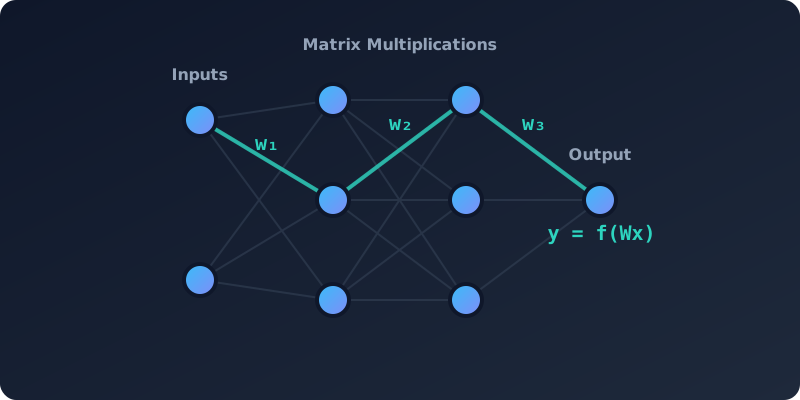
At its core, a neural network is a function: y = f(x). You feed it numbers, and it outputs numbers. The "network" part is just a way to structure this function using layers of parameters (weights and biases) that get multiplied and added together.
When you ask a model a question, it doesn't ponder. It converts your text into numbers (a process known as embeddings), pushes those numbers through billions of matrix multiplications, and spits out the most statistically probable next numbers. It’s calculus and linear algebra happening at a blistering scale.
Why "Deep" Learning?
The "deep" in deep learning just means there are many layers of these mathematical operations stacked together. A single layer can only draw straight lines through data. Stack enough layers and add non-linear activation functions, and the network can bend those lines into incredibly complex shapes, allowing it to categorize everything from a picture of a cat to the sentiment of a movie review.
The Learning Mechanism: Not Studying, Just Adjusting
How does this math engine "learn"? Through a deeply mechanical process called backpropagation.
Imagine trying to hit a target with a bow and arrow blindfolded, and someone shouts how far off you were. You adjust your aim slightly and try again. That’s backpropagation. The network makes a prediction, measures the error, and uses calculus (the chain rule) to trace that error backwards, tweaking every single weight by a tiny fraction so the next guess is slightly better. Repeat this across trillions of data points, and the math engine becomes remarkably accurate.
The Takeaway
Understanding neural networks requires stripping away the magic. They don't have intent, logic, or reasoning. They have matrices, gradients, and optimization algorithms. Once you see them as mathematical tools rather than artificial minds, the entire field becomes far less intimidating—and far more fascinating to build with.
(Correct as of September 2026).