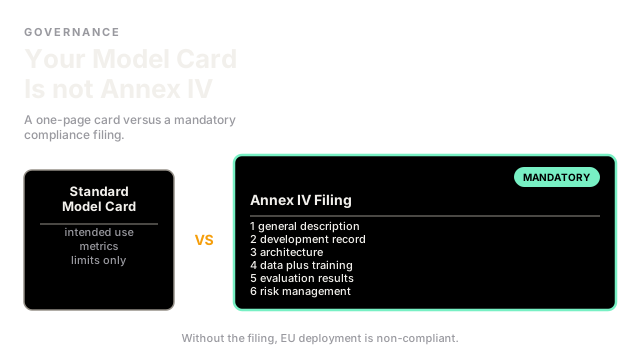
Your Model Card Isn't Annex IV
Why Does This Exist?
In the early 2020s, the "Model Card" became the gold standard for ML documentation. Introduced in a seminal paper, it was a one- or two-page summary of a model's intended use, performance, and biases. It was entirely voluntary. Companies released them for good PR, and if a section was inconvenient (like training data provenance), they just left it blank.
With the enforcement of the EU AI Act, that era is over. Annex IV of the Act mandates a specific, exhaustive list of technical documentation that must be maintained for high-risk AI systems. A markdown file on Hugging Face is no longer sufficient.
Think of It Like This
A standard model card is like the marketing brochure for a car. It tells you the horsepower, the safety rating, and the intended terrain. Annex IV documentation is the engineering blueprint and the factory audit log. It is a legally binding record of how the car was built, tested, and approved.
How It Actually Works
Annex IV requires deployers and providers to maintain a living document that includes, among other things:
- Design Specifications: Exact architecture details, hyperparameters, and the logic behind algorithmic choices.
- Data Provenance: Detailed descriptions of the training, validation, and testing datasets, including how they were collected, cleaned, and assessed for bias.
- Evaluation Metrics: Not just top-line accuracy, but disaggregated metrics across protected demographics, and the exact harnesses used to calculate them.
- Risk Management Log: A documented history of identified risks, how they were mitigated, and the residual risks that remain.
- Human Oversight Measures: Technical specifications of the UI and mechanisms designed to allow human operators to intervene or shut down the system.
If a regulatory body requests this documentation, you must provide it. If it is incomplete or materially false, you are liable.
Watch Out For
You cannot reverse-engineer this documentation after the model is built. Reconstructing data provenance months after a web scraping run is nearly impossible. Annex IV requires a cultural shift: documentation must be generated as a continuous artifact during the engineering process, not tacked on as a post-mortem chore.
(Correct as of August 2026).
The Quick Version
A standard open-source model card is a starting point, not a compliance filing. Under Annex IV of the EU AI Act, technical documentation must be exhaustive, covering exact data provenance, risk logs, and architectural specifications.