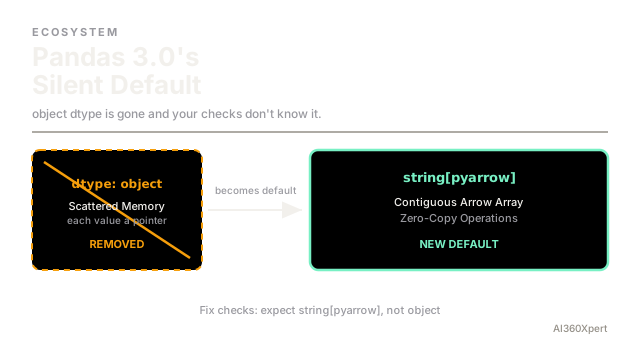
Pandas 3.0's Silent Default
Why Does This Exist?
For a decade, pandas stored strings in the absolute worst way possible. If you had a column of text, pandas defaulted to the object dtype. Under the hood, this meant creating a massive array of Python pointers, each pointing to a string object scattered randomly in memory. It was slow to read, slow to process, and consumed a shocking amount of RAM.
With pandas 3.0, the core team finally pulled the trigger on a breaking change: strings are now backed by Apache Arrow (string[pyarrow]) by default. The memory footprint collapsed, and string operations became blazingly fast. But it broke a lot of legacy code.
Think of It Like This
Imagine a library where the index cards just point to a random shelf in a massive warehouse (the object dtype). Retrieving ten books means running all over the building. PyArrow is like taking all those books and binding them together into a single, continuous volume. You can scan them instantly, but all your old index cards are now useless.
How It Actually Works
Apache Arrow is a cross-language development platform for in-memory analytics. It defines a standardized, columnar memory format. When pandas switched its default string engine to Arrow, it meant that string columns are now stored in contiguous blocks of memory, rather than as separate Python objects.
This allows for vectorized string operations (like .str.contains()) that run in C++ at the hardware level, completely bypassing the Python Global Interpreter Lock (GIL).
Watch Out For
The bug isn't the data; it's the schema checks. Thousands of data pipelines have validation code that looks like this: assert df['name'].dtype == 'object'. Because developers used object as a synonym for "string" for a decade, those assertions will now fail violently when they encounter string[pyarrow]. Furthermore, missing values behave slightly differently in the Arrow backend (<NA> vs NaN), which can break legacy downstream numpy code.
(Correct as of August 2026, referencing pandas 3.x releases).
The Quick Version
Pandas 3.0 replaced the memory-hogging object dtype with PyArrow-backed strings by default. It makes your code dramatically faster and lighter, but it will break any pipeline that relies on strict dtype assertions or legacy NumPy null handling.