AI Marketing in 2026: Why Multi-Modal Workflows Crushed Point Solutions
The landscape of content creation and marketing has completely transformed over the last two years. As of September 2026, compiling a list of "top AI tools" reveals a stark reality: the era of the isolated text generator or the standalone image synthesizer is functionally over. We are now entirely in the era of unified, multi-modal workflow engines.
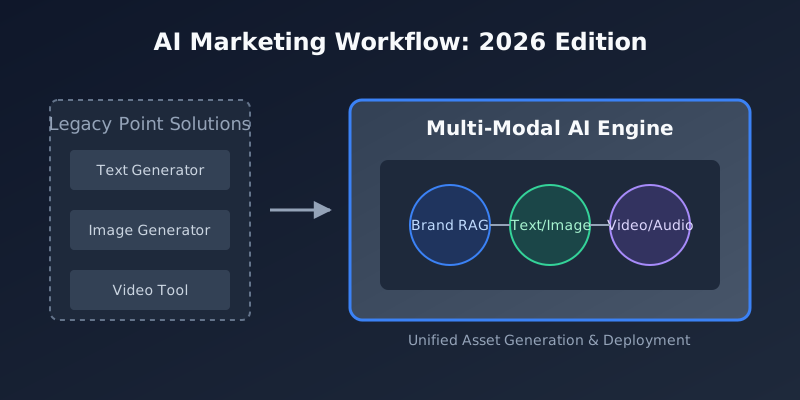
If your marketing stack relies on one AI tool for copywriting, a separate subscription for generating graphics, and yet another tool for slicing video, you are bleeding efficiency. Multi-modal integration isn't just a premium feature anymore—it's the baseline.
The Death of the Single-Purpose Generator
Just a couple of years ago, marketers were wowed by foundational tools that did one thing reasonably well. You asked an LLM to generate a blog post, and you asked a diffusion model to create an image. But as foundational models like Gemini 2 and GPT-4 evolved (and as highly specialized local models emerged via advanced post-training quantization techniques), the capability ceiling shifted.
The most effective tools in 2026 are orchestrators. They leverage robust RAG (Retrieval-Augmented Generation) pipelines to ground everything they produce in a brand's specific style guide, past performance metrics, and enterprise data. When you generate a campaign now, the system simultaneously drafts the copy, creates consistent visual assets, generates localized audio voiceovers, and predicts engagement scores based on historical data.
Standout Approaches in 2026
The real winners in the current ecosystem aren't necessarily the ones with the largest raw parameters, but those offering the smartest workflow integrations:
- Unified Brand Brains: Platforms that ingest a company's entire asset library as vector embeddings to ensure every piece of generated content instantly aligns with corporate voice and visual identity.
- Autonomous A/B Testing: Tools that not only generate creative assets but autonomously deploy them, measure sentiment, and iterate the prompt dynamically without human intervention.
- Hyper-Personalized Video: We've moved past static avatars. The best marketing AI now uses native video generation pipelines to create dynamic, context-aware video content at scale, adjusting the messaging and visual framing per user demographic in real-time.
The Pitfalls of "Stitched" Solutions
The trap many organizations are falling into is attempting to stitch together legacy AI point solutions using brittle API calls. This results in mismatched tone, hallucinatory brand assets, and massive technical debt. True ecosystem-level tools handle multi-modal generation natively within a single latent space—or at least within a tightly coupled agentic framework.
If you are still copy-pasting prompts between browser tabs to build a campaign, you're competing against automated, multi-agent systems that can spin up an entire cohesive funnel in seconds. The tools of 2026 demand that we stop thinking like operators of standalone machines, and start thinking like directors of integrated AI ecosystems.
(Correct as of September 2026).