Why You Should Ditch the API: The Top Open-Source LLMs for Local Inference
The days of assuming that you have to route every prompt through an expensive, latency-bound API endpoint are over. As of September 2026, the local open-source LLM ecosystem has crossed a major threshold. The models aren't just toys anymore; they're production-ready powerhouses that you can run on commodity hardware, offering profound advantages in privacy and speed.
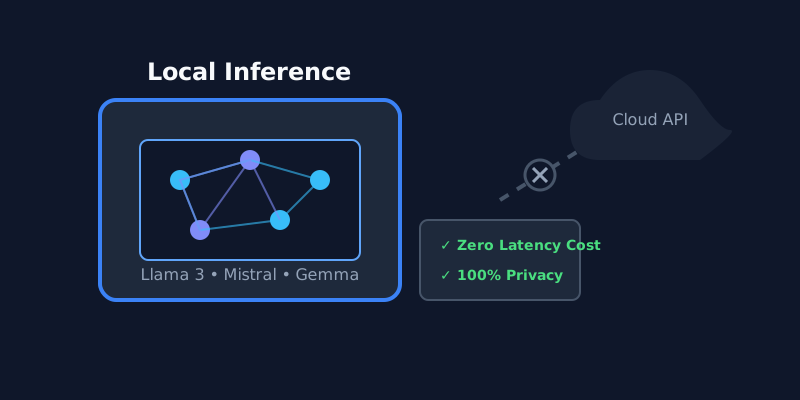
Running LLMs locally isn't just a gimmick anymore. With the latest small-parameter models, local inference offers real privacy and zero latency costs.
Why Local Execution Matters Right Now
If you're building systems that process sensitive data—think healthcare records or proprietary financial models—sending that data over the wire to a third-party provider introduces unacceptable risks. But it's not just about privacy. On-device inference fundamentally alters the economics of AI. You trade an ongoing, unpredictable operational expense (API tokens) for a fixed capital expense (your hardware).
The Heavyweights: Llama 3, Mistral, and Gemma
Right now, the conversation is dominated by three main families of open-source models:
- Meta's Llama 3 (8B and 70B): The undeniable king of open-weight performance. The 8B parameter version, specifically, is a marvel. When subjected to aggressive model quantization, it fits comfortably within the VRAM of a standard consumer GPU while punching far above its weight class in reasoning tasks.
- Mistral (Nemo and 7B-v0.3): Mistral continues to prioritize efficiency. Their models shine in constrained environments where you need high throughput without melting your hardware.
- Google's Gemma (2B and 9B): Built from the same research as Gemini, Gemma models offer an alternative architecture that excels in structured generation and coding tasks.
The Quantization Reality Check
We have to be honest, though. You aren't running a 70B model locally at full FP16 precision unless you have a server rack in your basement. The secret sauce making this entire local revolution possible is quantization. Converting these models to INT8 or even 4-bit precision (via formats like GGUF) is non-negotiable.
Yes, quantization introduces a slight degradation in nuanced reasoning, but for 95% of practical use cases—summarization, basic code assistance, drafting—the loss is completely imperceptible.
The Verdict
The narrative that you need massive cloud infrastructure to build useful AI features is a marketing tactic by cloud providers. If you haven't spun up Llama 3 on your local machine using LM Studio or Ollama, you're operating on outdated assumptions.
(Correct as of September 2026).