Stop Trying to Build AI Apps Without a Vector Database
Why The Old Tools Don't Work
Every time a team decides to bolt Generative AI onto their existing product, the first instinct is to shove everything into their existing Postgres or MongoDB instance. It’s familiar, it’s already provisioned, and nobody wants to manage another piece of infrastructure.
But a few weeks into building a RAG pipeline, reality hits. Traditional databases are built to find exact matches or simple text overlap. They don't understand that "feline" and "cat" are related. They completely lack the mathematical foundations to perform dense semantic search at scale.
The Mathematical Reality of AI
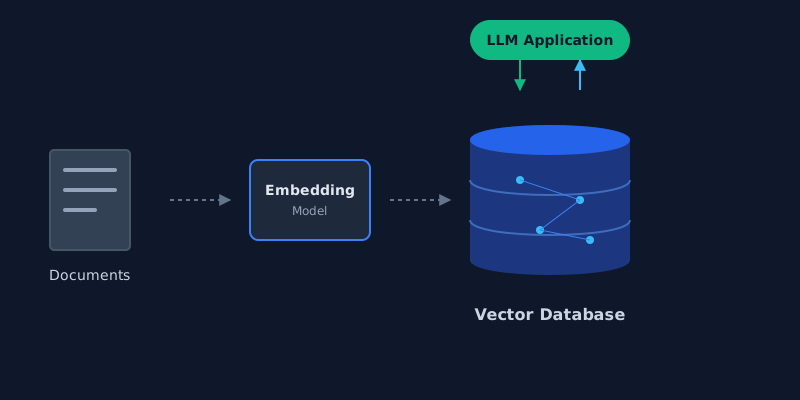
Modern LLMs don't read text; they process high-dimensional floating-point arrays called embeddings. When you take your company's knowledge base and pass it through an embedding model (like OpenAI's text-embedding-3-small or Cohere's embed-english-v3.0), each document becomes a vector of 1,536 or more numbers.
Finding the most relevant context for a user's prompt isn't a SQL WHERE clause—it's calculating the cosine distance between the prompt's vector and millions of document vectors. Traditional databases simply cannot do this fast enough. They will choke when doing a full-table scan on millions of high-dimensional vectors.
Enter the Vector Database
Vector databases (like Pinecone, Milvus, or Qdrant) are purpose-built for this exact operation. They don't do full-table scans. Instead, they use algorithms like HNSW (Hierarchical Navigable Small World) to index these vectors, allowing them to find the closest matches across billions of records in single-digit milliseconds.
When you adopt one of these managed cloud services, you aren't just buying storage—you are buying a highly optimized mathematical engine that makes real-time enterprise AI possible. Without it, your AI application will have unacceptable latency, poor retrieval accuracy, and spiraling compute costs.
(Correct as of September 2026).