Comparison
BERT vs GPT vs T5
Comparing encoder-only, decoder-only, and encoder-decoder transformer architectures.
Verdict: Use BERT for understanding tasks (classification, NER); use GPT for open-ended generation; use T5 for converting one sequence into another (translation, summarization).
Quick Version (TL;DR)
Comparing encoder-only, decoder-only, and encoder-decoder transformer architectures.
The Short Answer
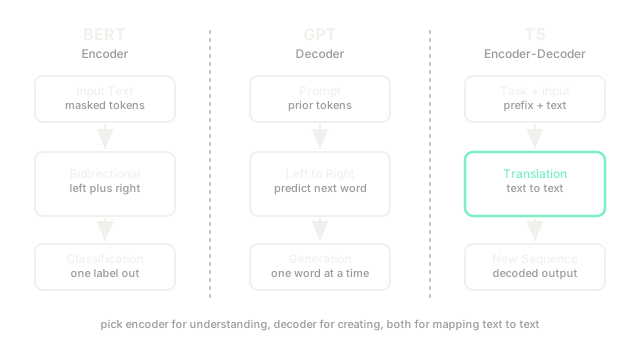
Though all three are built on the Transformer architecture, they use its parts differently. BERT is an encoder-only model designed to read text bidirectionally and understand it. GPT is a decoder-only model designed to read left-to-right and generate the next word. T5 is an encoder-decoder model designed to convert an input sequence into a completely new output sequence.
Where They Differ
| Feature | BERT (Encoder) | GPT (Decoder) | T5 (Encoder-Decoder) |
|---|---|---|---|
| Attention Mask | Bidirectional (can see future tokens in the input) | Causal (can only see past tokens) | Bidirectional encoder + Causal decoder |
| Training Objective | Masked Language Modeling (fill in the blank) | Causal Language Modeling (predict next word) | Span Corruption (predict missing spans) |
| Best Used For | Classification, NER, Sentiment Analysis, Extractive QA | Chatbots, Creative Writing, Code Generation | Translation, Summarization, Abstractive QA |
| Output Shape | One vector per input token | A new sequence of tokens | A new sequence of tokens |
Choose BERT When
- You need to classify or label text: If your task is "read this document and tell me if it's positive or negative", BERT's bidirectional context makes it incredibly accurate.
- You are building an embedding model: Dense retrieval models rely on the deep, two-way contextual embeddings that encoder architectures naturally produce.
Choose GPT When
- You need open-ended generation: GPT excels at continuing a prompt. If the task requires writing a paragraph, writing code, or holding a conversation, causal decoders are the industry standard.
- You are doing Few-Shot prompting: Decoder models have proven exceptionally good at in-context learning, adapting to patterns provided in the prompt without any gradient updates.
Choose T5 When
- Your task is strictly sequence-to-sequence: Translation (English to French) or summarization (long article to short paragraph) requires reading the entire input before deciding how to start generating the output. Encoder-decoders were explicitly designed for this.
What People Get Wrong
People often try to use GPT for tasks that BERT handles better, cheaper, and faster. You do not need a 7-billion parameter generative model to do binary sentiment classification on customer reviews; a fine-tuned 110-million parameter BERT model will often match its accuracy at a fraction of the latency and cost.