Comparison
Correlation vs Causation
Why predicting the future and changing the future require completely different types of models.
Verdict: If you just want to predict the future (e.g., forecasting sales), correlation is enough. If you want to change the future (e.g., increasing sales via a discount), you must have causation.
Quick Version (TL;DR)
Why predicting the future and changing the future require completely different types of models.
The Short Answer
Correlation simply means two things move together. When A goes up, B goes up (or down). Standard machine learning models (like XGBoost or Neural Networks) are essentially extremely powerful correlation engines.
Causation means that A makes B happen. There is a direct physical or logical mechanism linking them.
Where They Differ
| Feature | Correlation | Causation |
|---|---|---|
| Question Answered | If I observe A, what can I guess about B? | If I artificially change A, what will happen to B? |
| Statistical Tool | Standard Machine Learning, Pearson Coefficient. | Causal Inference, A/B Testing, Randomized Control Trials. |
| Directionality | Symmetrical (A correlates with B = B correlates with A). | Directional (A causes B, but B does not cause A). |
| Goal | Prediction / Forecasting. | Intervention / Policy Making. |
The "Intervention" Test
The easiest way to tell the difference is to ask: "What happens if I intervene?"
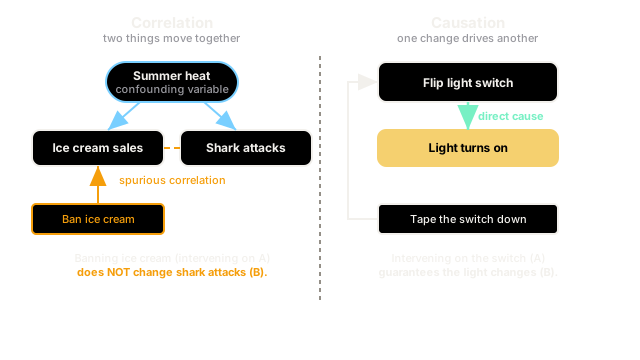
Consider the classic example: Ice cream sales and shark attacks are highly correlated. They both spike in July and drop in December.
If your goal is just prediction (Correlation), this is highly useful! If you see ice cream sales skyrocketing, you can accurately predict that shark attacks will also be high this week.
But what if you are the Mayor and your goal is intervention? You want to reduce shark attacks. If you ban ice cream (intervene on A), will shark attacks go down? No. Because the correlation is driven by a hidden third variable (Summer heat driving people to the beach).
If an intervention on A does not change B, you have correlation without causation.
Choose Correlation When
- Your goal is purely predictive forecasting: E.g., Predicting next month's server load based on web traffic. You don't care why traffic causes load, you just need to autoscale your servers.
- Intervention is impossible or unethical: E.g., You can't force people to smoke to see if it causes cancer, you can only observe the correlation.
- You are building standard classification/regression models: Standard ML assumes the training data was drawn randomly and passively from the real world without your intervention.
Choose Causation When
- You want to make a business decision that alters reality: E.g., "If we drop the price by 10%, will total revenue go up?" Standard ML might see that low prices historically correlated with clearance sales and predict low revenue. Causal inference tries to figure out what happens if you actively force the price down.
- You want to build a system that acts in the world: E.g., Reinforcement learning agents (like robots or game-playing AIs) inherently learn causation because they take actions and observe the consequences.
What People Get Wrong
Assuming more data solves confounding
If a dataset suffers from confounding (a hidden third variable driving both A and B), adding more rows to the dataset will not fix the problem. The model will just become more confident in the wrong causal relationship. You need causal inference techniques (like inverse probability weighting) or A/B testing, not just "Big Data."