Comparison
Dense vs Sparse vs Hybrid Retrieval
Comparing semantic vector search with exact keyword matching.
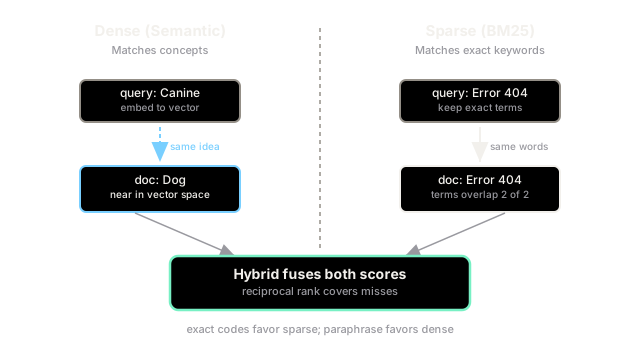
Verdict: Never rely purely on Dense Retrieval. Always use Hybrid Retrieval (Dense + BM25) to capture both the semantic meaning of a query and the exact serial numbers or keywords within it.
Quick Version (TL;DR)
Comparing semantic vector search with exact keyword matching.
The Short Answer
Dense Retrieval converts text into a high-dimensional vector (embedding) to find documents that share the same meaning, even if they use completely different words (e.g., matching "dog" with "canine"). Sparse Retrieval (like BM25) relies on exact keyword overlap, giving high scores to rare words. Hybrid Retrieval simply runs both searches in parallel and mathematically merges the scores using Reciprocal Rank Fusion (RRF) or a convex combination (alpha).
Where They Differ
| Feature | Dense (Vector) | Sparse (BM25) | Hybrid |
|---|---|---|---|
| Matching Style | Semantic / Conceptual | Exact Lexical (Keyword) | Both |
| Handles Synonyms? | Excellent | Poor | Excellent |
| Handles IDs & Acronyms? | Poor (Often hallucinates similarity) | Excellent | Excellent |
| Infrastructure | Vector Database (Pinecone, Qdrant) | Inverted Index (Elasticsearch) | Supported natively by modern databases |
Choose Dense Retrieval When
- Users ask natural language questions: If a user types "Why does my laptop battery die so fast?", dense embeddings will successfully retrieve documents mentioning "power consumption" and "lithium degradation", whereas BM25 would strictly look for "battery" and "die".
Choose Sparse Retrieval When
- You are searching for exact identifiers: If a user searches for "Error Code 0x80070005" or "SKU-9921", embedding models completely fail. They map strict IDs to nearby arbitrary numbers in vector space. Sparse retrieval instantly finds the exact string match.
Choose Hybrid Retrieval When
- You are building a production RAG system: There is almost no scenario where pure Dense Retrieval outperforms Hybrid Retrieval in a production setting. Combining the broad semantic recall of vectors with the precise keyword matching of BM25 covers the blind spots of both algorithms.
What People Get Wrong
People assume that because Vector Databases and LLMs are new, BM25 (invented in the 1990s) is obsolete. In reality, evaluating any modern search system on domain-specific data (like medical records or legal contracts) shows that BM25 often outperforms pure Dense Retrieval because domain-specific jargon doesn't embed well in generalized models like OpenAI's text-embedding-3.