Comparison
Reranking vs Better Embeddings
Comparing two strategies for improving search quality in a RAG pipeline.
Verdict: Always add a Reranker first; it is a drop-in API call that massively boosts quality. Only upgrade your Embedding model if retrieval is still failing, as it requires re-indexing your entire database.
Quick Version (TL;DR)
Comparing two strategies for improving search quality in a RAG pipeline.
The Short Answer
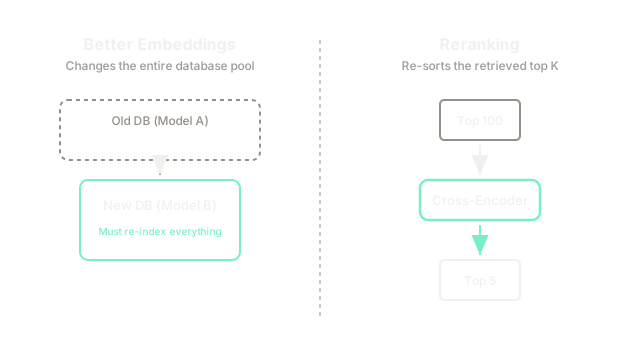
When search fails in RAG, you have two main levers. Better Embeddings means swapping out your Bi-Encoder (e.g., moving from ada-002 to text-embedding-3), which changes the fundamental geometry of how all your documents are stored. Reranking means leaving the embeddings alone, retrieving the top 100 documents as usual, and then passing them through a powerful Cross-Encoder (like Cohere Rerank or BGE-Reranker) to meticulously re-sort them and pass only the absolute best 5 to the LLM.
Where They Differ
| Feature | Better Embedding Model | Adding a Reranker |
|---|---|---|
| Model Type | Bi-Encoder (embeds query and doc separately) | Cross-Encoder (reads query and doc together) |
| Implementation Effort | High (must re-embed and index all data) | Minimal (add one API call after retrieval) |
| Accuracy Impact | Moderate (improves broad recall) | Massive (highly optimizes precision at Top-K) |
| Compute Cost | One-time high cost (indexing) | Continuous high cost at runtime |
Choose A Reranker When
- You want the highest immediate ROI: Adding a reranking step (often called a "two-stage retrieval pipeline") is universally accepted as the easiest way to jump 10–20% in retrieval accuracy without touching your database infrastructure.
- Precision at Top-3 is critical: Because Cross-Encoders evaluate the query and the document simultaneously (allowing attention mechanisms to interact across them), they are exceptionally good at spotting when a document has the right keywords but answers a different question.
Choose Better Embeddings When
- Your baseline recall is terrible: A reranker can only re-sort the top 100 documents given to it. If the embedding model is so bad that the correct document isn't even in the top 100, the reranker has nothing to work with.
- You are processing massive scale at low latency: Reranking is computationally heavy. If you have strict millisecond latency budgets, you cannot afford to run a Cross-Encoder at runtime and must rely purely on a highly optimized embedding model.
What People Get Wrong
People often delay adding a Reranker because they assume it requires deploying another massive model. In reality, managed APIs (like Cohere) or tiny open-weight models (like bge-reranker-base) can be dropped into an existing LangChain or LlamaIndex pipeline with three lines of code, offering a massive upgrade essentially for free.