Comparison
Transformer vs State Space Model
Comparing quadratic recall mechanisms with linear-time continuous state inference.
Verdict: Use Transformers when absolute recall across the entire context window is critical; use State Space Models (like Mamba) when infinite context length or constant-memory inference is required.
Quick Version (TL;DR)
Comparing quadratic recall mechanisms with linear-time continuous state inference.
The Short Answer
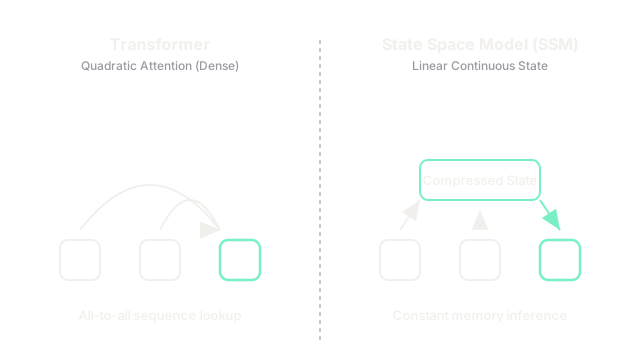
Transformers read the entire sequence context using self-attention, meaning inference gets quadratically slower and memory-heavy as the context grows. State Space Models (SSMs) are a modern evolution of recurrent networks that compress history into a dynamic hidden state, allowing inference to remain constant time regardless of how long the sequence gets, while still training in parallel.
Where They Differ
| Feature | Transformer | State Space Model (SSM) |
|---|---|---|
| Inference Cost | Scales with context length (must compute against the entire KV cache) | Constant time (only updates the current state vector) |
| Memory Footprint | Large (stores all past tokens) | Tiny (stores a fixed-size state) |
| Information Recall | Perfect (can retrieve exact tokens from a million steps ago) | Lossy (must decide what to compress into the state) |
| Hardware Utilization | Extremely high (dense matrix multiplications) | High (modern implementations like Mamba train in parallel via hardware-aware scans) |
Choose A When
- You need perfect in-context recall: For tasks like coding or document Q&A, the model often needs to perfectly copy a variable name or a specific quote from thousands of tokens ago. Transformers excel at exact retrieval.
Choose B When
- You need unbounded context lengths: If you are processing hours of continuous audio, DNA sequences, or infinite telemetry streams, a Transformer will quickly run out of memory. SSMs can run forever.
- You are constrained by edge hardware: Constant memory inference makes SSMs highly attractive for embedded systems and mobile devices.
What People Get Wrong
People often assume SSMs are just "RNNs that work." While they share the recurrent property during inference, modern SSMs are built on control theory and continuous-time differential equations, allowing them to be discretized and computed as a parallel convolution during training. This parallel training is what actually makes them competitive with Transformers.