Comparison
Vector vs Relational vs Graph Store
Comparing three distinct database architectures and when to use them.
Verdict: Use a Relational DB (PostgreSQL) for 90% of all software; use a Vector DB purely to hold semantic text for RAG; use a Graph DB only when traversing highly complex, multi-hop entity relationships.
Quick Version (TL;DR)
Comparing three distinct database architectures and when to use them.
The Short Answer
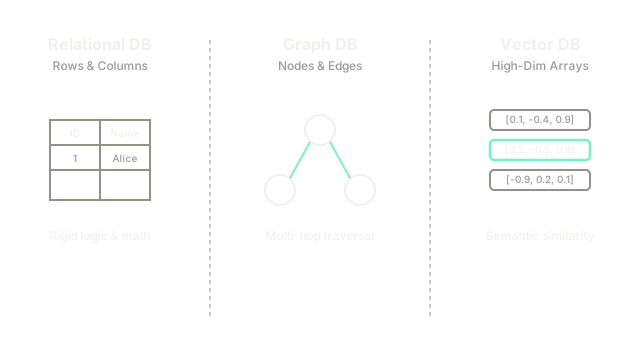
A Relational Store (like PostgreSQL or MySQL) organizes rigid data into tables (rows and columns) that map perfectly to strict business logic. A Graph Store (like Neo4j) stores entities as nodes and connects them with explicit, traversable edges (relationships). A Vector Store (like Pinecone or Qdrant) stores unstructured data (text, images) as high-dimensional arrays of numbers, allowing you to search for concepts rather than exact keywords.
Where They Differ
| Feature | Relational (SQL) | Graph | Vector |
|---|---|---|---|
| Data Structure | Tables with strict schemas | Nodes and Edges | Lists of floating-point numbers |
| Primary Query Mechanism | Exact Match (WHERE id=5) | Traversal (MATCH (a)-[KNOWS]->(b)) | Nearest Neighbor (Cosine Similarity) |
| Flexibility | Rigid | Highly flexible schema | No schema (just vectors and metadata) |
| AI Integration | Used for Text-to-SQL agents | Used for GraphRAG | Used for standard Document RAG |
Choose a Relational Store When
- You are building an application: 95% of the world runs on relational databases. If you need to store users, passwords, transaction records, or product inventory, PostgreSQL is the only correct answer. It guarantees ACID compliance (data integrity).
Choose a Graph Store When
- You are querying highly connected networks: If your goal is "Find friends of friends who bought the same product," a SQL database requires massive, slow
JOINoperations. A Graph database is explicitly designed for multi-hop traversal and executes these queries instantly. - You are doing fraud detection or supply chain tracking: Where tracing the exact lineage of an entity is the entire purpose of the application.
Choose a Vector Store When
- You are building a semantic search engine: If you want users to search a library of PDFs by asking natural language questions, standard databases fail. Vector databases are strictly designed to hold embeddings generated by an LLM and find the mathematical "closest" vectors in milliseconds.
What People Get Wrong
With the AI boom, people incorrectly assume they should dump all their data into a Vector Database. Vector databases cannot do math, they cannot group by date, and they cannot enforce unique constraints. Most modern applications are adopting a hybrid approach: using a robust Relational Database (like PostgreSQL with pgvector) that can simultaneously store strict tabular data alongside vector embeddings in the same table.