Code Execution Agents
Guessing math in words fails. Write a short script, run it apart from the chat, and read back the exact result.
Why Does This Exist?
A model predicts words, not sums. Ask it for the average of 120, 80, 200, and 150 and it may say 140 with full confidence. The shape looks right and the arithmetic is wrong. That failure grows with data size: a five-megabyte log cannot be counted by eye, and a guess is worthless when money or access depends on it.
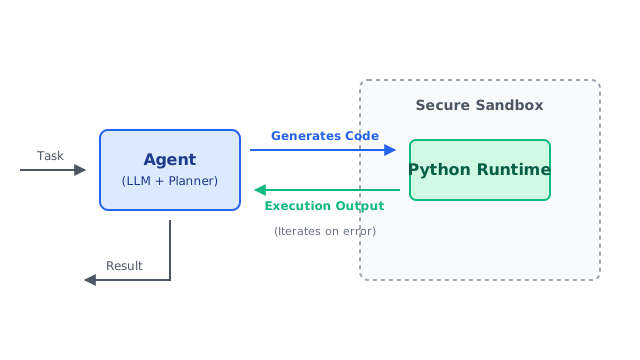
Code execution agents stop guessing and start running. The agent writes a small script, the framework runs it in an isolated sandbox, and the printed number comes back as an observation. Chain-of-thought agents supply the plan that decides a script is needed, agentic workflow evaluation later scores whether the run was tidy, human-in-the-loop agents gate the risky runs, and groups of such agents can show emergent behavior when they share results.
This page covers the write, run, and read-back cycle. It does not cover which sandbox to buy or how to orchestrate many agents. Those are deployment choices that sit on top of this loop.
Basics first: a sandbox is an isolated place to run untrusted code, with no access to your files or keys. If that is new, think of it as a disposable computer that is wiped after each run. Everything below assumes code never runs on your own machine directly.
Think of It Like This
The manager and the calculator
A sharp manager plans well but does mental math poorly. Ask for the average revenue across four regions and you get a fast, rounded guess.
Hand that manager a calculator and the habit changes. They type the four numbers, press equals, and read back 137.5. The plan is still theirs. The arithmetic belongs to the machine.
Where it stops: a calculator cannot type a wrong formula for you and will happily average the wrong column. The agent still has to pick the right numbers and check that the script read what it meant to read.
How It Actually Works
Call the plan , which means the written decision that a script is needed. Call the script , which means the code the model wrote. Call the result , which means the text the sandbox printed back. The loop is then then , and becomes the fact the next Thought uses.
From words to a run
The agent first writes : load the four revenues and average them. It then writes in a fenced block the framework can extract. The framework takes into the sandbox, runs it with a time limit, and pastes back. If is a stack trace, the agent reads the error, fixes , and tries again.
Worked example
Revenues: 120, 80, 200, 150.
Add them: . Count them: 4. Divide: .
A word-only answer often says 140 because it blends the numbers. The script returns 137.5 every time, and the diagram shows that number travelling back into the chat as the trusted value. The same loop scales to a file with a million rows, where the only change is that reads the file instead of listing four numbers.
Use this loop when the answer needs exact math, filtering, or parsing. Keep it off when a sentence is enough, because each run costs time and needs guardrails.
Code
This snippet is the trusted part of the loop with only the standard library. It averages the four numbers and shows the retry signal a sandbox returns:
def mean(values: list[float]) -> float: return sum(values) / len(values)
revenues: list[float] = [120.0, 80.0, 200.0, 150.0]print(mean(revenues)) # -> 137.5print(sum(revenues)) # -> 550.0print(len(revenues)) # -> 4Three prints, one fact. The sum is 550.0, the count is 4, and the mean is 137.5. An agent would paste that 137.5 back as the observation instead of defending a guessed 140.
Watch Out For
A loop with no time limit eats the server
The model writes while True or a deep recursion, and the sandbox runs it forever.
The symptom is a hung run that burns CPU until someone kills it. Every run needs a timeout such as 10 seconds plus a memory cap, and the framework must treat a timeout as an observation the agent can read. Test the limit with a deliberate sleep before you trust it.
The sandbox can reach your keys
The script reads files or network it should never see, because the sandbox runs with your permissions.
The symptom is quiet: nothing fails, but a printed path or variable shows host data leaking into the trace. Run untrusted code in an isolated container with no secrets mounted, no host filesystem, and no open network unless the task needs it. A human approval step belongs in front of any call that touches real data or money.
The Quick Version
- Code execution agents write a script from a plan and read back the sandbox result as fact.
- Word-only math guesses. The script for 120, 80, 200, and 150 returns 550.0 over 4, which is 137.5 every time.
- Errors come back as text too, so the agent can fix the script and retry.
- Every run needs a timeout and a memory cap, because models write infinite loops.
- Never run agent code with your own permissions. Isolate it and gate risky calls with human approval.
- The loop is for exact work: math, filtering, and parsing. Sentences do not need it.