Multi-Agent Orchestration
Multi-agent orchestration coordinates multiple specialized agents working in parallel or in sequence toward a shared goal — combining their diverse capabilities while managing communication, task delegation, and conflict resolution between them.
Why Does This Exist?
A single agent with a large context window and many tools can handle complex tasks, but it has limits: the context fills up, tool calls become slow, and mixing many responsibilities in one agent produces confused behavior. Multi-agent systems solve this with specialization and parallelism: a researcher agent focuses on information gathering, a writer agent focuses on synthesis, a critic agent reviews the output — each doing its one job well, orchestrated by a supervisor.
The result can solve tasks that are too large, complex, or diverse for any single agent.
Think of It Like This
A production team making a documentary
A solo filmmaker can make a short film. To make a feature documentary, you need a director (orchestrator), a research team (research agents), a camera crew (data collection agents), an editor (synthesis agent), and a fact-checker (critic agent). Each specialist is better at their role than any generalist, and they work in parallel. The director doesn't do the camera work — they coordinate the whole production. Multi-agent orchestration is the director's role.
How It Actually Works
The supervisor-worker pattern
The most common multi-agent pattern:
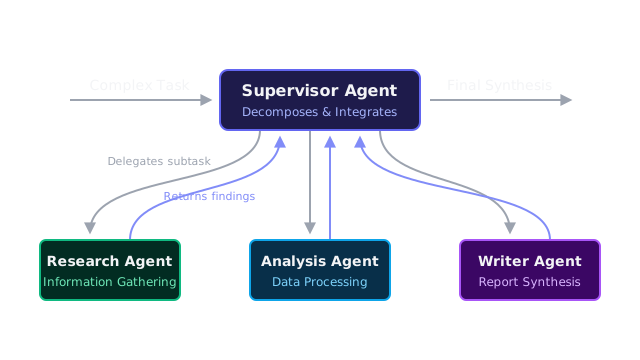
Supervisor agent: Receives the goal, decomposes it into sub-tasks, delegates each to a worker agent, collects results, and synthesizes the final output.
Worker agents: Each specialized for a specific domain or capability:
- Research worker: Web search and document retrieval
- Code worker: Python execution and debugging
- Analysis worker: Statistical analysis and data processing
- Writer worker: Text synthesis and formatting
Workers report results back to the supervisor, which decides whether to accept, retry, or re-delegate.
Parallel execution
For tasks with independent sub-goals, workers execute simultaneously:
Supervisor: "Research these 5 topics" → Worker 1: Topic A (running) → Worker 2: Topic B (running) → Worker 3: Topic C (running) → Worker 4: Topic D (running) → Worker 5: Topic E (running)Supervisor: [collect results] → synthesizeThis reduces total wall-clock time from to (bounded by the slowest worker) for n independent tasks.
Communication patterns
| Pattern | Description | Use case |
|---|---|---|
| Hub-and-spoke | All agents communicate through a central supervisor | Simple task routing |
| Peer-to-peer | Agents communicate directly with each other | Debate, negotiation |
| Blackboard | Agents read/write shared state | Collaborative document editing |
| Pipeline | Output of agent A is input to agent B | Sequential transformation |
Conflict resolution
When workers return conflicting results (different sources give different facts):
- Voting: majority wins (works when agents are independent)
- Confidence weighting: weight results by agent-reported confidence
- Critic agent: a dedicated agent evaluates competing results and picks or reconciles them
- Human escalation: defer to a human reviewer for high-stakes conflicts
Code
# Multi-agent system with LangGraph (graph-based orchestration)from langchain_openai import ChatOpenAIfrom langchain_core.messages import HumanMessage, SystemMessagefrom langgraph.graph import Graph, ENDfrom typing import TypedDict, Annotatedimport operator
llm = ChatOpenAI(model="gpt-4o-mini", temperature=0)
# ── Agent state ────────────────────────────────────────────────────────────────class AgentState(TypedDict): goal: str research_results: list[str] analysis: str final_report: str messages: Annotated[list, operator.add]
# ── Worker agents ─────────────────────────────────────────────────────────────def research_agent(state: AgentState) -> AgentState: """Research worker: gather information on the goal.""" response = llm.invoke([ SystemMessage(content="You are a research specialist. Find key facts."), HumanMessage(content=f"Research this topic: {state['goal']}"), ]) results = [response.content] return {**state, "research_results": results, "messages": [("research_agent", response.content)]}
def analysis_agent(state: AgentState) -> AgentState: """Analysis worker: analyze the research findings.""" research_text = "\n".join(state.get("research_results", [])) response = llm.invoke([ SystemMessage(content="You are an analytical specialist. Extract key insights."), HumanMessage(content=f"Analyze these findings:\n{research_text}"), ]) return {**state, "analysis": response.content, "messages": [("analysis_agent", response.content)]}
def writer_agent(state: AgentState) -> AgentState: """Writer worker: produce the final report.""" response = llm.invoke([ SystemMessage(content="You are a technical writer. Produce clear, structured reports."), HumanMessage(content=f"Write a report on: {state['goal']}\n\nAnalysis:\n{state['analysis']}"), ]) return {**state, "final_report": response.content, "messages": [("writer_agent", response.content)]}
def supervisor(state: AgentState) -> str: """Supervisor decides next step based on current state.""" if not state.get("research_results"): return "research" elif not state.get("analysis"): return "analyze" elif not state.get("final_report"): return "write" else: return END
# ── Build the graph ────────────────────────────────────────────────────────────workflow = Graph()workflow.add_node("research", research_agent)workflow.add_node("analyze", analysis_agent)workflow.add_node("write", writer_agent)
workflow.set_conditional_entry_point(supervisor)workflow.add_conditional_edges("research", supervisor)workflow.add_conditional_edges("analyze", supervisor)workflow.add_conditional_edges("write", supervisor)
app = workflow.compile()
# Run the multi-agent pipelineresult = app.invoke({ "goal": "Summarize the key benefits of vector databases for ML systems", "research_results": [], "analysis": "", "final_report": "", "messages": [],})
print("Final Report:")print(result["final_report"])print(f"\nSteps taken: {len(result['messages'])}")Watch Out For
Cascading failures and error propagation
When a worker agent fails, the supervisor must decide whether to retry, skip, or abort. If failure detection is missing, the supervisor may pass incomplete or wrong results to the next agent — errors propagate and compound. Implement explicit success/failure status in every agent's output, and build retry logic with exponential backoff and fallback strategies.
Context window explosion at the supervisor
If the supervisor receives the full output of every worker for a long task, its context window fills rapidly. Implement summarization at each worker: workers return structured summaries, not raw outputs. Only escalate raw details to the supervisor when there's ambiguity or conflict requiring human-readable context.
The Quick Version
- Multi-agent systems coordinate specialized agents — each expert in its domain — through a supervisor.
- The supervisor-worker pattern: supervisor decomposes goals, delegates to workers, synthesizes results.
- Parallel execution of independent sub-tasks reduces wall-clock time from O(n) to O(1).
- Communication patterns: hub-and-spoke, peer-to-peer, blackboard, pipeline.
- Key failure modes: cascading errors, context bloat, and missing conflict resolution.