Human Oversight of AI Decisions
Models guess from patterns and sometimes guess confidently wrong. Oversight puts a person at approval, monitoring, or command so errors get caught and someone owns the call.
Why Does This Exist?
A model approves 199 loans correctly and one disastrously, with the same confident tone throughout. Nobody notices until the appeal lands. That gap between fluency and reliability is why a person has to own the decision.
Oversight answers two asks at once. It catches the errors the model cannot see, from edge cases to quiet bias. And it fixes responsibility: when the system harms someone, a named human or board approved the deployment, set the limits, and can stop it. Rules such as the EU AI Act now demand exactly this for high-risk uses.
This page covers the three working patterns and how to size them honestly. For the training side that tries to make the model itself safer, read safety alignment. For what the model should ultimately serve, read value alignment.
Think of It Like This
Autopilot with pilots still in the seats
A modern jet can hold course, altitude, and even land itself on a clear day. Yet two pilots sit up front. They watch for the day that is not clear: a failed sensor, volcanic ash, or a runway change the computer never trained on. They can grab the controls and own the outcome.
Oversight is that cockpit for models. The system flies the routine volume while people handle the strange cases, check the instruments, and take the blame when it matters.
Where it stops: a plane shakes and alarms when something breaks, while a model fails quietly in perfect prose. So reviewers need more than a window: uncertainty scores, samples to audit, and a real stop button.
How It Actually Works
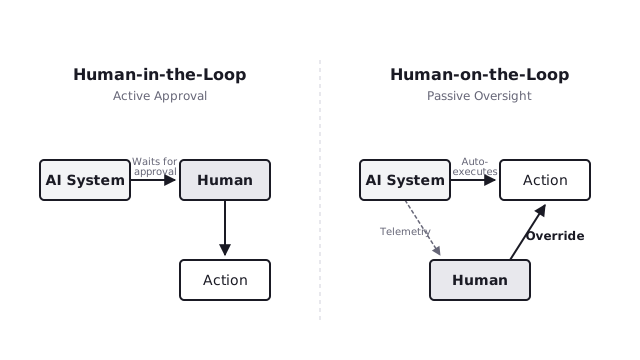
Three patterns cover most deployments. Each names who decides, when the human acts, and what happens without them.
Human in the loop approves each call
The model proposes, the person disposes. Nothing ships without a click. Write for cases per day, for review minutes per case, and workload . Write capacity for reviewer minutes per shift. This pattern needs , or the queue grows without bound.
Use it for high stakes and low volume: final diagnoses, single hires, individual lending decisions. The cost is latency and wages. The gain is a real second mind on every call.
Human on the loop monitors and can stop
The model acts alone while a person watches dashboards and holds a stop control. The human intervenes by exception: drift alarms, confidence drops, or a manual kill switch. Write for the fraction of planted test errors the monitor catches during a shift. If slides, the loop is decorative.
Use it for fast volume where per-item approval is hopeless: fraud scoring, content ranking, trading guardrails. The cost is vigilance engineering. The gain is speed with a brake.
Human in command sets the boundaries
Leaders decide where the system may run, on whom, under which limits, and when it gets pulled. This is review boards, deployment checklists, quarterly audits, and the authority to decommission. It is the only pattern that governs the other two.
Worked example with 200 cases and one shift
A queue holds flagged posts. Review takes minutes each. One reviewer works an 8-hour shift, so minutes.
- Workload: minutes, which is 10 hours.
- Shortfall: minutes over capacity.
- Most this reviewer can finish: cases.
- Left for tomorrow or another reviewer: cases.
The diagram shows this exact queue: 200 in, 160 checked, 40 deferred. Per-item approval does not fit, so the team must sample the 200 by risk, add reviewers, or switch to monitored autonomy with audits. Sizing first is what keeps oversight honest.
Watch Out For
Nodding along with a confident model
Symptom: the model is right 98 percent of the time, so reviews become clicks. A planted test with 20 synthetic errors catches only 6, giving . The human is a rubber stamp.
Fix: add friction where it matters. Require a one-line reason or a checklist tap for approvals, show the model uncertainty beside the recommendation, rotate shifts, and rerun synthetic probes until recovers.
A monitor screen with no brake attached
Symptom: dashboards glow green while the on-call person has no kill switch, no rollback, and no page that wakes anyone. When drift hits at night, the model keeps acting for hours.
Fix: ship the stop control with the dashboard. Define who can halt serving, how long a halt takes, and what runs in the meantime. Test the halt like a fire drill before you need it.
The Quick Version
- Oversight keeps a person responsible for model decisions and edge cases.
- In the loop means a human approves each call and needs workload within capacity .
- On the loop means the model acts while a human monitors and can stop it.
- In command means leaders set where the system runs and when it gets pulled.
- Our queue of 200 cases at 3 minutes each needs 600 minutes, but one shift holds 480, so 40 cases must wait or move to monitored autonomy.
- Watch for rubber-stamping when accuracy is high and for dashboards that cannot actually stop the system.