Biometrics Vision
Face, iris, and fingerprint models turn body patterns into match scores, so a phone unlocks for you and blocks strangers.
Why Does This Exist?
Passwords leak and cards get lost. Bodies stay. Biometric vision exists to verify identity from face, iris, or fingerprint with a measured error tradeoff: let the owner in fast, keep strangers out. Phones, borders, and vaults all use the same core: enroll a template, compare a probe, threshold the score.
Detection starts it. Face detection finds the face. Face verification scores the match. This page is the decision layer: embeddings, distance, thresholds, and liveness that blocks photos.
Basics first: an embedding is a vector that places same persons close. Cosine similarity near 1 means same, near 0 means different. The threshold picks the false accept rate you can live with.
Think of It Like This
A bouncer with a guest list photo
A bouncer holds your ID photo, looks at you, and waves you in if the match feels strong enough, otherwise asks for a second check. Embeddings are the mental photo code. The threshold is how strict the bouncer feels that night. The analogy stops at memory: the bouncer learns you over visits, while the template stays frozen unless re enrolled.
How It Actually Works
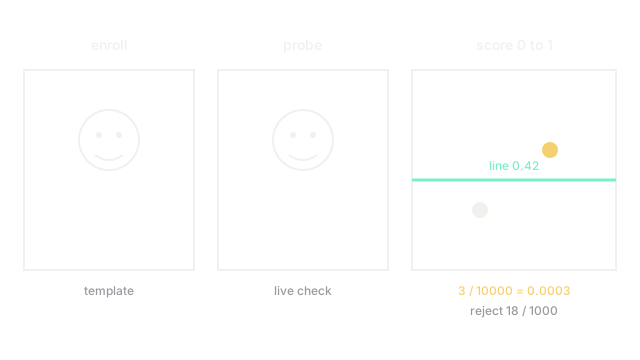
Enrollment captures several images, aligns by landmarks, and averages embeddings into a template. At unlock, the probe embeds, compares by cosine to the template, and accepts if above threshold. ArcFace trains that space with an angular margin so same persons cluster tight. Liveness runs alongside: blink, depth, or texture checks reject prints and screens.
Lighting and age are the assumptions. Train on bright adults and test on dim teens and scores shift. Keep capture distance and light in range, or widen the template with varied enrolls.
Worked threshold pick
Ten thousand stranger trials score below 0.42 except 3 that cross. False accept rate is 3 divided by 10000 which equals 0.0003. Owner trials accept 982 of 1000 at the same line, false reject rate 18 divided by 1000 which equals 0.018. Moving the line to 0.48 drops strangers to 0 but rejects 61 owners, a tradeoff product picks, not research.
Watch Out For
Photo spoofs that pass a still matcher
Holding a printed face or a video to the camera matches the template with no live person present. The symptom is perfect lab accuracy with field break ins. Fix it with active liveness such as depth or challenge response, never a single still image check.
The Quick Version
- Biometrics enrolls a template, scores probes by similarity, thresholds the call.
- ArcFace style margins tighten same person clusters.
- Our line at 0.42 gives false accept 0.0003 and false reject 0.018.
- Liveness blocks photos and screens alongside matching.
- Pick thresholds by product risk, not by accuracy alone.