BRIEF Binary Descriptor
BRIEF describes a patch with a string of brightness comparisons, so matching becomes a fast count of differing bits.
Why Does This Exist?
Float descriptors like SIFT match well but cost memory and distance time. A float vector needs bytes and Euclidean math. Binary strings need bytes for bits and one XOR plus popcount.
BRIEF supplies that speed. It pairs with any detector, often CenSurE or FAST, and turns each patch into comparisons. Learn the general trade in feature descriptors, then use BRIEF when microseconds matter.
Think of It Like This
Spot the difference checklist
Instead of describing two faces in words, you run one checklist: is the left eye brighter than the nose, is the chin darker than the ear, repeated times. Same person gives nearly the same yes no list.
That list is BRIEF. Smoothing first avoids judging by one noisy pixel. The analogy stops at rotation: spin the face and the fixed checklist compares the wrong spots.
How It Actually Works
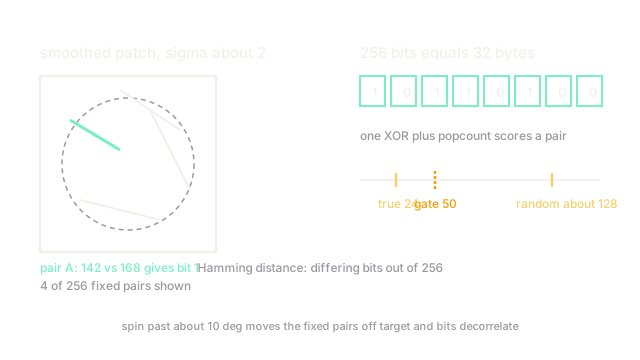
Smooth the patch with a Gaussian to calm noise. Take fixed offset pairs sampled once from a Gaussian layout. For each pair set bit to when , else . Standard BRIEF uses bits.
Worked numbers
With pairs, one descriptor is bytes. Suppose two true views differ in bits, so Hamming distance . Random patches differ near half the bits, about . A matcher that keeps distances under and applies the ratio test keeps the true pair and drops most random ones. Smoothing with typically cuts the true distance by a third on noisy video versus no smoothing.
BRIEF has no orientation or scale logic. Rotate past about degrees and bits decorrelate fast. That weakness is exactly what ORB fixes by steering the pairs.
Watch Out For
Skipping the smoothing step
Raw pixels make each comparison a coin flip under sensor noise. Hamming distances inflate and good pairs fail the ratio test. Always blur before comparing, even if your detector already blurred for detection.
Using BRIEF on rotated sets
BRIEF assumes roughly upright patches. Phone roll or aerial yaw breaks it. Switch to ORB or SIFT when rotation exceeds a few degrees.
The Quick Version
- BRIEF stores , , or brightness comparisons as bits.
- Gaussian smoothing comes before any test.
- Hamming distance replaces Euclidean math.
- Tiny and very fast, but rotation sensitive.
- Best paired with an external detector on upright, near scale video.