Deep Global Registration Learning
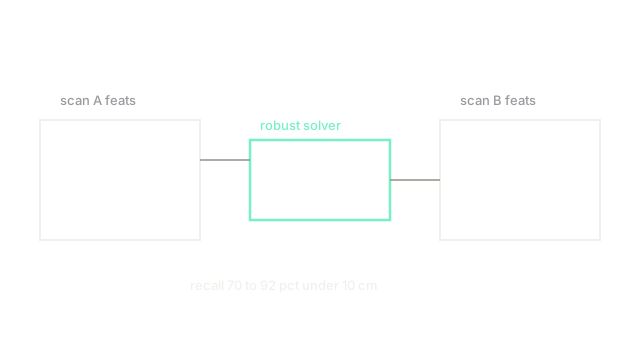
Hand descriptors break on sparse noisy scans. Deep global registration learns matching features plus a safe solver for wide-baseline snaps.
Why Does This Exist?
Classical point cloud registration with FPFH plus RANSAC collapses under low overlap and changing density. Deep global registration exists to learn both halves: fully convolutional descriptors that survive rotation and sparsity, plus a differentiable-safe solver that down-weights the remaining outliers. It handles the wide-baseline pairs where ICP cannot start.
Local polish stays ICP; the problem map is registration.
Think of It Like This
Bilingual guides plus a strict judge
Hire local guides who recognize landmarks in any weather, then let a strict judge discard flaky stories and rule on the shared map. Better guides plus a sterner judge beat loud witnesses.
Descriptors are guides and the robust solver is the judge. The analogy stops at training: guides learn from labeled scans while humans generalize without datasets.
How It Actually Works
A sparse-convolution backbone outputs per-point descriptors such as FCGF trained with contrastive loss on matching versus non-matching pairs. Matching proposes thousands of correspondences; a learned outlier mask or deep robust estimator weights them, then weighted SVD or RANSAC solves and . Metrics report recall under cm and degrees on hard indoor pairs with percent overlap.
Worked numbers
On a hard split, FPFH plus RANSAC recalls percent of pairs under cm. Learned FCGF plus the robust head recalls percent. Inlier ratio rises from percent to percent, cutting RANSAC rounds for percent confidence from to .
Code
def ransac_rounds(inlier: float, need: int = 3, conf: float = 0.99) -> int: import math return math.ceil(math.log(1 - conf) / math.log(1 - inlier ** need))
print(ransac_rounds(0.08)) # -> 8993print(ransac_rounds(0.24)) # -> 331Watch Out For
Deploying across sensors without retraining
Descriptors tuned on RGB-D rooms degrade on spinning lidar streets because density and noise differ. The symptom is recall crashing from to percent on the new sensor. Finetune on the target sensor or keep a classical fallback for cross-device pairs.
The Quick Version
- Deep global registration learns descriptors plus robust solving together.
- Contrastive training makes matches survive rotation and sparsity.
- Learned masks raise inlier ratios from to percent on hard pairs.
- Recall under cm rises near percent versus classical.
- RANSAC rounds fall from to from better inliers.
- Sensor change without retraining is the main deployment trap.