HF Diffusers Image Generation
Pipelines plus swappable schedulers for diffusion image generation, so one prompt reaches pictures in a few lines.
Why Does This Exist?
Diffusion generation has many moving parts: text encoder, UNet, scheduler, decoder. Wiring them by hand means version drift and unreadable scripts. Diffusers standardizes the assembly into pipelines with interchangeable schedulers, so Stable Diffusion and friends run from a checkpoint id with a sampler choice. It serves image generation and text-to-image work.
This page covers the pipeline contract, one latent-size fixture, and appropriate use. Series 0.39 was the current release verified in-session.
Think of It Like This
A darkroom with swappable timers
The enlarger, trays and paper stay fixed while the timer box swaps: fast timer for proofs, slow timer for exhibition prints. Same negative, different patience, visibly different grain.
Diffusers pipelines are the darkroom, schedulers are the timers. The analogy stops at chemistry: timers never change the negative, while schedulers genuinely change the sampling path and the picture.
How It Actually Works
Input is a checkpoint id plus prompt, scheduler choice, step count and seed. Output is decoded images from denoised latents. Purpose is reproducible diffusion inference with mix-and-match parts: pipelines own the assembly, schedulers own the speed-quality trade, models own the blocks. Appropriate use is standard text-to-image and editing flows at pinned versions. Keep the seed fixed when comparing schedulers, or randomness masks the sampler difference.
Latent fixture
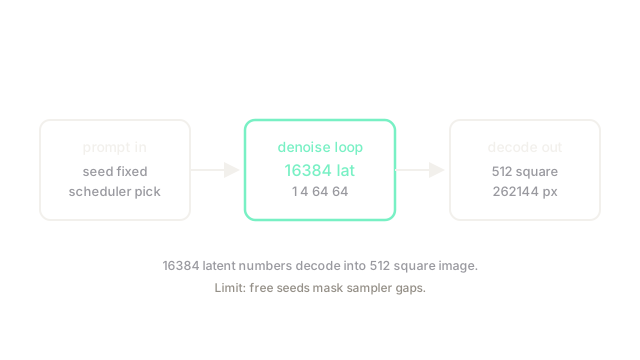
Take one latent of shape . The count is numbers. Decoding upsamples per side into a image, which is why latent steps are cheap and the decoder dominates memory.
Code
Latent counting in plain Python:
def latent_count(channels: int, h: int, w: int) -> int: return channels * h * w # batch of one
print(latent_count(4, 64, 64)) # -> 16384print(512 * 512) # -> 26214416384 latent numbers decode into 262144 image pixels.
Watch Out For
Comparing schedulers without fixing the seed
Different seeds change the starting noise, which moves the picture more than most schedulers do. The symptom is a sampler ranking that flips every rerun. Fix it by pinning one seed across the comparison and varying only steps and scheduler.
The Quick Version
- Diffusers maps checkpoint plus prompt and scheduler to decoded images.
- One 1 by 4 by 64 by 64 latent holds exactly 16384 numbers.
- The decoder expands it 8 times per side into 512 by 512 pixels.
- Use pipelines for standard generation with pinned versions.
- Fix the seed before ranking schedulers.