MOT Challenge Tracking Set
Crowded pedestrian scenes with consistent IDs per person, the shared ground for multi-object tracking and identity scoring.
Why Does This Exist?
Detection finds boxes per frame, tracking must keep names across frames through crowds and occlusions. MOT Challenge collected crowded pedestrian scenes with one consistent ID per person, so multi-object trackers could be compared on identical identity rules.
This page covers ID contract and scoring use. Metrics are in tracking metrics.
Think of It Like This
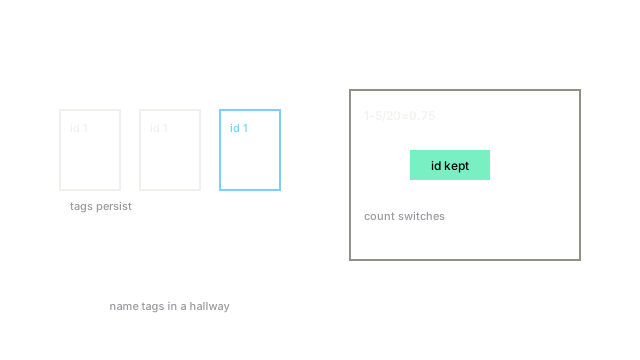
Name tags in a busy hallway
A hallway fills with people weaving past each other. Each keeps one name tag from entry to exit, even when briefly hidden behind others.
That tag persistence is MOT. Losing a tag or swapping two is the error being counted.
How It Actually Works
Purpose is pedestrian multi-object tracking. Inputs are video frames, outputs are boxes with consistent IDs. Appropriate use is benchmarking association plus detection under crowds. Density and occlusion slices matter more than one headline.
Toy MOTA walkthrough
Take 20 truth boxes with 2 misses, 2 false alarms and 1 switch. MOTA is . The single switch costs less than misses here, which mirrors why IDF1 is reported alongside.
Code
MOTA with switch pressure visible.
def mota(miss: int, fp: int, switch: int, total: int) -> float: return round(1 - (miss + fp + switch) / max(total, 1), 3)
print(mota(2, 2, 1, 20))# -> 0.75Two misses plus two false alarms plus one switch on twenty gives 0.75.
Watch Out For
Tuning detectors while identities drift
Strong boxes with weak association lift MOTA yet scramble IDs. The symptom is happy headlines with jumping counts in stores. Fix it by gating on IDF1 and switch counts too.
The Quick Version
- MOT Challenge maps crowded frames to boxes with persistent person IDs.
- Inputs are frames, outputs are ID-consistent boxes across time.
- Toy 2 misses, 2 false alarms and 1 switch on 20 gives 0.75 MOTA.
- Use it to benchmark crowded pedestrian tracking.
- Report switches and IDF1 beside MOTA.