Open3D Point Cloud Tools
An editable point cloud and mesh workbench: read, clean, register and view 3D captures with a few direct calls.
Why Does This Exist?
Depth sensors hand over unordered point lists with noise, holes and no alignment. Learning starts only after geometry is clean: outliers removed, normals estimated, clouds registered into one frame. Open3D is the workbench for that stage. It reads clouds and meshes, filters and downsamples them, runs registration into shared coordinates, and previews the result, feeding point cloud processing and meshes.
This page covers the geometry contract, one distance fixture, and appropriate use.
Think of It Like This
A stonemason yard
Rough blocks arrive dusty and unaligned. The yard washes each block, chisels the wobble off, measures faces, then slots blocks onto shared pins before carving starts.
Open3D is the yard. Filtering is the wash, downsampling is the rough chisel, registration is the pinning. The analogy stops at material: stone removal is forever, while voxel filters keep a reversible record of the original points.
How It Actually Works
Input is a point cloud or mesh plus an operation: read, voxel downsample, outlier removal, normal estimation, or pairwise registration. Output is edited geometry in the same frame, ready for learning or meshing. Purpose is clean, aligned 3D captures with inspectable steps. Appropriate use is preprocessing and visualization before model training. Tune voxel size deliberately: one setting too large erases the very edges the downstream task needs.
Distance fixture
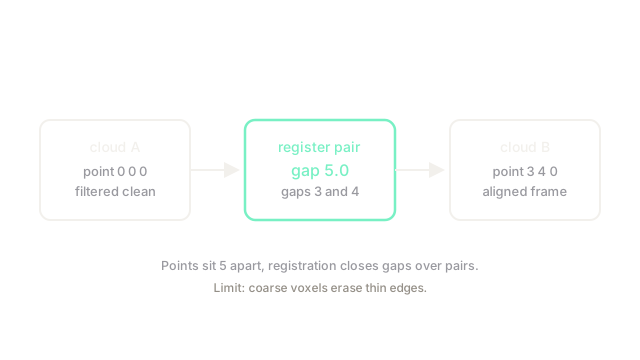
Take points and . Gaps are , , . Squared sum is . Distance is units. Registration minimizes such gaps over thousands of pairs, which is why one honest distance anchors the whole idea.
Code
Distance in plain Python:
import math
def dist(a: tuple[float, float, float], b: tuple[float, float, float]) -> float: return math.sqrt(sum((x - y) ** 2 for x, y in zip(a, b))) # euclidean gap
print(round(dist((0.0, 0.0, 0.0), (3.0, 4.0, 0.0)), 3)) # -> 5.0Gaps 3 and 4 give exactly 5.0.
Watch Out For
Downsampling away the evaluation detail
A large voxel reads clean and trains fast, then test objects with thin structures vanish. The symptom is strong validation beside weak deployment on rails and wires. Fix it by fixing voxel size from the smallest feature you must keep, not from speed.
The Quick Version
- Open3D maps raw clouds and meshes to cleaned, aligned geometry.
- Points 0,0,0 and 3,4,0 sit exactly 5 units apart.
- Registration minimizes such gaps over thousands of pairs.
- Use it for preprocessing and viewing before 3D learning.
- Size voxels from the smallest kept feature, not from speed.