SOLO and SOLOv2 Masks
SOLO turns instance segmentation into grid-cell classification: each cell predicts the mask of the object whose centre falls inside it.
Why Does This Exist?
Boxes are an awkward middleman for masks: they need anchors, NMS tuning, and RoI alignment, all inherited from detection. SOLO (Wang et al., 2020) drops them. Divide the image into an grid; cell predicts the class of whatever object centres there plus its full-image mask. Two people side by side fall in different cells and separate naturally. SOLOv2 replaces static per-cell channels with dynamic kernels predicted per cell, sharpening masks and adding Matrix NMS.
Think of It Like This
Assigned seats with portrait duties
A classroom grid assigns every student a seat. The rule: whoever sits in a chair paints the full portrait of the classmate whose centre of mass is over that chair. Neighbours never fight over one canvas because centres fall in exactly one seat. SOLOv2 upgrades each painter from a fixed stencil to a custom brush mixed for that sitter.
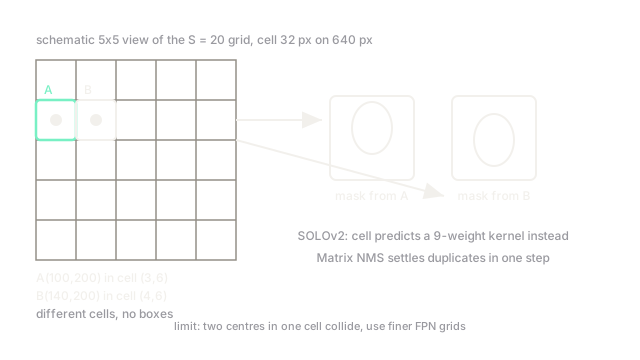
Where it stops: twins sharing one chair (two centres in one cell) still collide, so grids must be fine enough.
How It Actually Works
FPN levels use grids like to per side matched to object scale. Each cell outputs class scores and an mask (SOLO) or a kernel convolved over mask features (SOLOv2). Centre sampling assigns positives; Dice plus focal losses train masks. Matrix NMS decays duplicate scores in one parallel step using mask IoU instead of sequential box suppression.
Worked example
grid on a image: each cell spans pixels. Person A centres at , cell . Person B centres at , cell . Different cells, so each predicts its own mask channel with no box overlap logic. SOLOv2 instead predicts a -weight kernel per active cell and convolves it over a feature map to render the mask on demand.
Code
# Grid cell assignment for two centres on a 640px image with S=20.S, size = 20, 640for name, x, y in [("A", 100, 200), ("B", 140, 200)]: print(name, (int(x // (size / S)), int(y // (size / S))))# -> A (3, 6)# -> B (4, 6)Watch Out For
Coarse grids merging neighbours
Small puts two centres in one cell and one mask wins. Symptom: merged twins in crowds. Fix: use FPN-matched fine grids for small objects and confirm centre separation on validation crops.
Porting box NMS thresholds to Matrix NMS
Box-tuned IoU thresholds oversuppress soft mask duplicates. Symptom: missing overlapping instances. Fix: retune the Matrix NMS decay for mask IoU; do not copy detector settings.
The Quick Version
- SOLO predicts one mask per grid cell keyed by object centre, with no boxes or anchors.
- FPN levels carry different grid sizes matched to object scale.
- SOLOv2 predicts dynamic kernels per cell for sharper, cheaper masks.
- Matrix NMS suppresses duplicates in one parallel mask-IoU step.
- Grids must be fine enough that neighbour centres separate.