Spatial Filtering and Edge Detection
Spatial filtering applies a small matrix (a kernel) across an image to transform its pixels based on their neighbors, enabling tasks like blurring, sharpening, and detecting edges.
Why Does This Exist?
Raw images are simply grids of numbers representing pixel intensities. To make sense of them, a machine needs to identify meaningful structures like boundaries, corners, and textures. Without an intermediate step to extract these features, interpreting raw pixels directly is extremely brittle.
Spatial filtering solves this by looking at local neighborhoods of pixels rather than isolated points. By mathematically combining a pixel with its immediate neighbors, filters can emphasize important structural information (like edges) or suppress noise, creating a foundational representation that subsequent algorithms or neural networks can easily process.
Think of It Like This
Looking through a textured window pane
Imagine sliding a small, heavily patterned piece of glass over a photograph. If the glass has a vertical slit (the kernel), it will only let through light where there are strong vertical lines in the photo beneath it (the edges). As you slide the glass across the entire photo, you generate a new image that only contains the vertical outlines of the original scene. This sliding action is exactly what a spatial filter does numerically.
How It Actually Works
The Convolution Operation
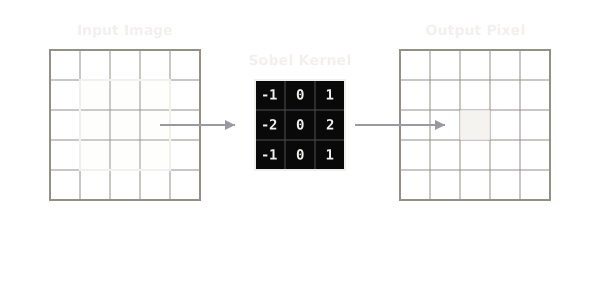
At the core of spatial filtering is the mathematical operation of convolution (or more accurately in image processing, cross-correlation). We define a small grid of numbers called a kernel or filter mask (typically 3×3 or 5×5).
- Center the kernel: Place the center of the kernel over a target pixel in the image.
- Multiply and sum: Multiply each value in the kernel by the corresponding pixel intensity underneath it, and add all these products together.
- Assign the new value: The resulting sum becomes the new value for the target pixel in the output image.
- Slide: Move the kernel to the next pixel and repeat the process.
Edge Detection: The Sobel Operator
Edges in an image correspond to areas where the pixel intensity changes rapidly (a high gradient). We can detect these changes by using specific kernels designed to approximate the derivative of the image.
The Sobel operator uses two 3×3 kernels to detect edges in the horizontal () and vertical () directions:
When you apply , a region of uniform intensity results in a sum of zero. But if there is a sharp transition from dark (left) to light (right), the positive numbers on the right side of the kernel will multiply with high pixel values, yielding a strong positive response — indicating a vertical edge.
To find the overall edge magnitude and direction at any pixel, you combine the responses from both kernels:
Padding and Strides
When the kernel is at the very edge of the image, part of it hangs outside the image boundary. Padding adds artificial pixels (usually zeros) around the border so the output image remains the same size. The stride is how many pixels the kernel moves at a time; a stride of 1 slides pixel by pixel, while a larger stride downsamples the image.
Code
import numpy as npimport matplotlib.pyplot as pltfrom scipy.signal import convolve2dfrom skimage import color, data
# Load a sample image and convert to grayscaleimage = color.rgb2gray(data.astronaut())
# Define a Sobel kernel for vertical edge detectionsobel_x = np.array([ [-1, 0, 1], [-2, 0, 2], [-1, 0, 1]])
# Apply spatial convolution# mode='same' applies zero-padding to keep the output size identicaledges_x = convolve2d(image, sobel_x, mode='same', boundary='fill', fillvalue=0)
# The output edges_x contains positive and negative values.# To visualize, we take the absolute magnitude.edge_magnitude = np.abs(edges_x)
print(f"Original shape: {image.shape}") # -> Original shape: (512, 512)print(f"Filtered shape: {edge_magnitude.shape}") # -> Filtered shape: (512, 512)Watch Out For
Noise amplification by derivative filters
Because edge detectors rely on finding rapid changes in intensity (derivatives), they are extremely sensitive to high-frequency image noise. A single noisy pixel will cause a massive spike in the edge response. To fix this, always apply a smoothing filter (like a Gaussian blur) to the image before applying an edge detection kernel.
Negative pixel values
Applying kernels with negative weights (like Sobel) will naturally produce negative values in the output array. If you try to save or display this output directly as a standard 8-bit image (0–255), the negative values will underflow or clip to zero, destroying half your data. You must take the absolute magnitude or properly rescale the values before display.
The Quick Version
- Spatial filters transform an image by multiplying a small matrix (a kernel) across every pixel's local neighborhood.
- The operation involves multiplying overlapping values and summing them to create a new pixel.
- Edge detection kernels (like the Sobel operator) find boundaries by acting as discrete derivatives, highlighting areas of rapid intensity change.
- Kernels can be designed for blurring, sharpening, or feature extraction, forming the basis of Convolutional Neural Networks (CNNs).
- Always smooth images before edge detection to avoid amplifying noise.