TrOCR Transformer Text Reader
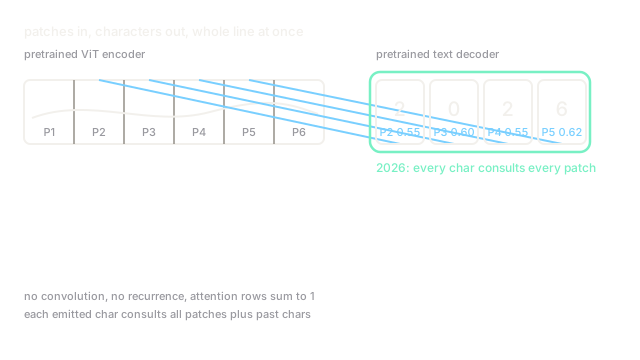
TrOCR reads text with transformers on both ends: image patches go in, characters come out, with no convolution or recurrence anywhere.
Why Does This Exist?
CRNN designs read left to right through recurrence, which bottlenecks long lines and leans on convolutional habits from natural images. Meanwhile transformers pre-trained on mountains of text and images learned richer priors. TrOCR exists to spend those priors on reading: a vision transformer encodes the line image into patches, a language-model-style decoder emits characters with full attention over the image. Handwriting and dense documents gain the most, where context spans the whole line. It lives inside text recognition.
Think of It Like This
A scholar with photographic recall
A scholar who has read ten thousand books glances at a smudged manuscript line and fills the gap from everything ever read, eyes flicking across the whole line at once rather than letter by letter. TrOCR's decoder cross-attends the same way: every emitted character consults every image patch plus every character so far. The analogy stops at the pre-training: the scholar studied language, while TrOCR's encoder studied images and its decoder studied text, fused only at fine-tuning.
How It Actually Works
The line image splits into 16x16 patches embedded by a pre-trained vision transformer (DeiT-style). A pre-trained text transformer decoder (RoBERTa-style) generates characters autoregressively, cross-attending to patch encodings at each step. Two-stage pre-training (hundreds of millions of synthetic printed lines, then real data) precedes fine-tuning on handwriting or receipts. Beam search over the decoder sharpens hard lines.
A worked glance
A handwritten "minimum" blurs its middle humps into six identical strokes. A recurrent reader committing left to right risks "munimum" early. TrOCR's decoder, emitting the fourth character, attends across all patches at once: the word's total width plus the dotted i later in line constrain the count, and the top beam holds "minimum" at 0.62 over "munimum" at 0.21. Whole-line attention beats local commitment.
Watch Out For
Decoder hallucinations on empty patches
Strong language priors complete words that are not there, turning coffee stains into "the". The symptom is fluent, confident, wrong transcriptions on noisy crops. Fix it by thresholding on visual grounding (attention spread), and by feeding the detector cleaner boxes rather than trusting the reader to abstain.
The Quick Version
- Image transformer encodes patches; text transformer decodes characters.
- No CNN or RNN: attention spans the whole line at every step.
- Massive synthetic pre-training precedes real-data fine-tuning.
- Handwriting and dense documents improve most from long-range context.
- Strong priors can hallucinate, so ground outputs in the image.