Video Question Answering
What happened before the car turned? Video QA answers language questions about footage, forcing models to find evidence across frames instead of one lucky image.
Why Does This Exist?
Image QA ports to video too easily: sample a frame, answer from it, ignore time. A large share of early video benchmarks proved solvable from single frames — models scored competitively while blind to motion, order, and cause. Leaderboards certified frame classifiers as video understanders.
VideoQA exists to demand time. Its questions need multiple frames (before/after, counting across shots, motive from sequences), and strong systems retrieve relevant moments first (temporal grounding) then reason over them. The image-QA sibling is visual commonsense reasoning; the backbone is video foundation models.
The one idea you need first. Retrieve-then-read splits QA into grounding (find the seconds that matter) and reasoning (answer from those seconds). The split is inspectable: wrong answers trace to missed moments versus misread ones, and each half improves independently. End-to-end averages fuse both failure modes into one inscrutable score.
Think of It Like This
A trial lawyer versus a headline reader
Asked what happened at the harbor, the headline reader answers from one photo: "a boat." The trial lawyer exhibits timestamped footage: the approach at , the wake at , the mooring at — then argues from exhibits. Cross-examination attacks the exhibits (wrong timestamps?) and the argument (wrong inference?) separately.
VideoQA grades lawyers. Retrieval exhibits the moments; reasoning argues from them; error analysis cross-examines each half. Single-frame models are headline readers testifying — occasionally right, never reliable, always overconfident.
How It Actually Works
Standard systems encode the question, retrieve top moments with a grounding head, encode those densely, and fuse question-plus-moments through cross-attention into answer logits (multiple choice) or generated text (open-ended). Question types route differently: factoid questions read one moment, temporal questions order several, counting questions aggregate across many. Training balances answer loss with auxiliary grounding supervision so retrieval learns instead of freeloading on language priors.
Open-ended scoring uses language-model judges or constrained vocabularies; multiple-choice stays the reliable workhorse.
Worked example
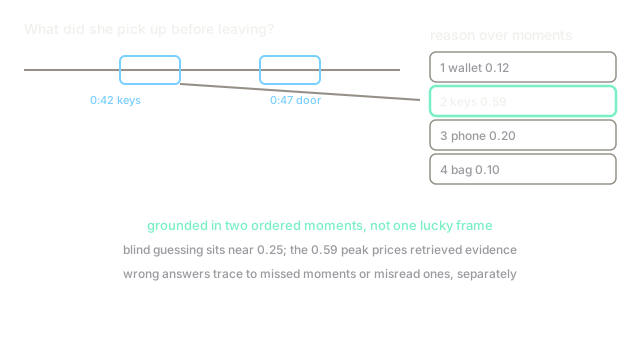
"What did she pick up before leaving?" Choice logits: . Exponentials: . Sum: . Probabilities: .
Choice ("keys, at , before the door at ") wins at — grounded in two ordered moments, not one lucky frame. A blind model guessing from question priors would spread mass evenly and land near ; the peak prices the retrieved evidence.
Code
The point of this snippet is the verdict arithmetic: logits to probabilities, peak to answer.
import math
def choose(logits: list) -> tuple: exps = [math.exp(z) for z in logits] total = sum(exps) probs = [e / total for e in exps] best = max(range(len(probs)), key=probs.__getitem__) return best, round(probs[best], 3)
print(choose([0.5, 2.1, 1.0, 0.3])) # -> (1, 0.588)Watch Out For
Benchmarks solvable from one frame
When most questions answer from a single well-chosen frame, retrieval machinery is decoration: frame samplers with language priors match dedicated video systems. Teams then "improve VideoQA" by improving frame guessing, and temporal reasoning never gets selected for.
Audit frame-solvability (one-frame baseline versus full system) and prioritize questions the baseline fails. Benchmarks are only as temporal as their hardest necessary subset.
Language priors answering blind
"Why" questions skew to motive answers, "how many" to small numbers — blind models (no video) score embarrassingly well by parroting the skew. Multimodal systems can ride the same priors while their video branch idles.
Report blind baselines beside every result and test on prior-shifted splits. A video model barely beating blind is a language model with a camera attached.
The Quick Version
- VideoQA answers language questions needing multi-frame evidence, not lucky frames.
- Retrieve-then-read separates moment finding from reasoning, making errors diagnosable.
- The worked fixture gives probabilities with choice winning.
- Audit single-frame solvability or benchmarks reward frame guessing as understanding.
- Blind baselines expose language priors; video branches must earn their keep above them.