Viola-Jones Face Detection
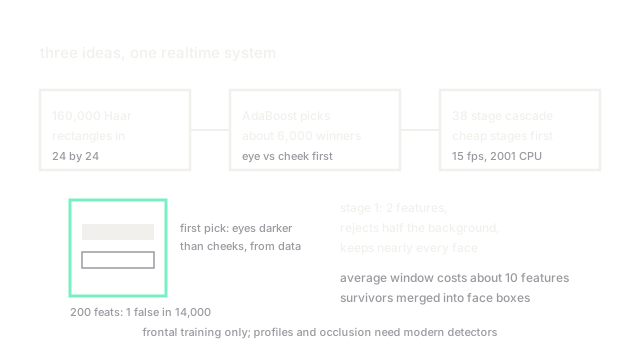
Viola-Jones made realtime face detection real by stacking three ideas. Fast rectangle features, AdaBoost picking the winners, and a cascade that rejects boring windows early.
Why Does This Exist?
In 2001, face detection was either accurate or fast, never both. Neural networks of the era took seconds per image; fast methods missed too many faces to use. Paul Viola and Michael Jones wanted faces found in realtime video on ordinary hardware, with no GPU in sight.
Their answer combined three existing ideas into one system: Haar-like features evaluated through an integral image, AdaBoost selecting a few winning features out of a huge pool, and an attentional cascade that spends computation only on face-like windows. The result ran at 15 frames per second on a 700 MHz Pentium and detected faces about as well as the best slow methods. It shipped in real cameras for a decade and still runs in OpenCV's classic detector. If you only want the features and cascade mechanics, read Haar cascades; this page covers the full three-part system and why the combination worked.
Think of It Like This
Hiring with knockout rounds
You have 160,000 applicants and one job. You do not interview everyone deeply. Round one is a two-question screen that anyone qualified passes and that eliminates half the pile in seconds. Each later round is harder and costlier, given only to survivors. The final round is a full-day interview for a handful of finalists.
Viola-Jones interviews windows that way. The 160,000 applicants are the possible rectangle features in a window. AdaBoost is the hiring committee picking which questions actually discriminate. The cascade is the round structure: a two-feature first stage, then stages of tens and hundreds of features, so the average window is rejected after about ten feature evaluations.
How It Actually Works
1. A huge pool of features
A detection window admits over 160,000 distinct Haar-like rectangles at all positions, sizes, and types. Nobody could hand-pick the good ones, and using all of them per window would be hopelessly slow. The pool is the raw material; selection does the real work.
2. AdaBoost picks the winners and weights them
AdaBoost trains weak one-feature classifiers one round at a time, reweighting the training faces so each new feature must fix the mistakes of the ones before it. The famous result: the first feature chosen compares eye-region darkness against cheek brightness, rediscovering from data what humans would have guessed. A 200-feature boosted classifier reaches high detection rates with a false positive rate around 1 in 14,000, and the final published cascade stacks about 6,000 features across 38 stages.
3. The cascade makes it realtime
Stages are ordered by cost: the first stage uses 2 features and rejects roughly half of all background while keeping effectively every face. Each later stage is stricter. Because real images are almost entirely background, the average window exits after a few stages, and the detector sustains 15 fps on 2001 hardware. Overlapping survivor windows get merged into final face boxes.
Watch Out For
Trained frontal means frontal only
The original cascade trained on upright frontal faces, and that is all it reliably finds. Sunglasses, masks, profiles, and strong rotation break the learned contrasts silently: no error, just missing boxes. Face detection and recognition covers modern detectors that survive pose and occlusion.
Scanning every scale costs real time
The window must rescan the image at every pyramid scale, typically shrinking by 25 percent per step. Coarse scale steps miss faces between sizes; fine steps multiply runtime. If small faces vanish while big ones detect fine, the scale factor, not the cascade, is misconfigured.
The Quick Version
- Viola-Jones fuses fast rectangle features, AdaBoost selection, and a cascade into one realtime system.
- A window offers over 160,000 features; AdaBoost keeps a few thousand that matter.
- The two-feature first stage rejects half the background while keeping nearly every face.
- About 6,000 features across 38 stages reach 15 fps on a 2001-era CPU.
- Frontal-pose training is a hard limit; occluded and profile faces need modern detectors.