Benchmark Contamination
When the answers to your evaluation test accidentally leak into your training dataset, giving the model a falsely inflated score because it memorized rather than learned.
Why Does This Exist?
In classical machine learning, preventing test set leakage is straightforward: you take a single CSV file, run an 80/20 random split, train on the 80, and test on the 20. Because you control the pipeline end-to-end, you can mathematically guarantee that the test data was never seen during training.
In modern deep learning—particularly with large language models and foundation models—this guarantee disappears. Models are pretrained on massive, indiscriminately scraped web corpora (e.g., Common Crawl or GitHub). Simultaneously, popular evaluation benchmarks (like MMLU, GSM8K, or HumanEval) are published openly on the internet so researchers can use them.
Because the benchmarks are on the internet, and the training data is the internet, the model inevitably reads the test questions and answers during training. When you later evaluate the model on that benchmark and it scores 85%, you have no idea if it actually learned to reason through the problem, or if it simply memorized the answer key it read on a GitHub repo. This is benchmark contamination, and it renders evaluation metrics completely meaningless.
Think of It Like This
Think of It Like This
Think of benchmark contamination like a student preparing for a final exam.
The student is supposed to study textbooks and lectures (the pretraining corpus) to learn the underlying concepts. To test if they actually learned the material, the teacher gives them a final exam with novel questions.
However, a previous teacher accidentally posted the exam's exact questions and answers on a public bulletin board. The student finds the board, memorizes the answers, and scores a 100% on the final. The student appears to be a genius, but they actually learned nothing about the subject. They just memorized the test.
How It Actually Works
Solving benchmark contamination requires two distinct processes: detection (measuring how badly a model is already contaminated) and decontamination (cleaning the dataset before training).
Detection: Did the model cheat?
If a model is already trained and you suspect it memorized the benchmark, you can run a contamination analysis. The most common technique is to prompt the model with the first half of a highly specific test question and see if it can autocomplete the rest perfectly.
For example, if you feed the model the prompt: "A train leaves Chicago at 45 mph heading..." and the model outputs the exact phrasing of a known benchmark question down to the punctuation, it has memorized the test. Another statistical method is to measure the perplexity (the model's "surprise") of the benchmark text. If the model finds the benchmark text significantly less surprising than average text, it is highly likely that it saw that exact text during training.
Decontamination: Fixing the pipeline
To prevent contamination from happening in the first place, you must rigorously filter the training corpus before training begins. This is computationally expensive given the scale of modern datasets.
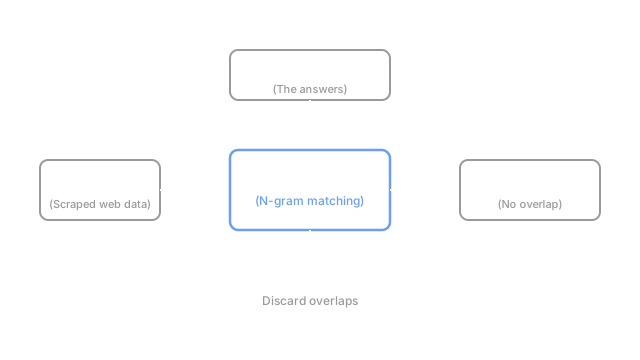
- N-gram Overlap: The standard industry approach is to break every question and answer in the benchmark into chunks of text (usually 13-grams or 14-grams). The pipeline then scans the entire multi-terabyte training corpus. Any document in the training corpus that shares a matching n-gram with the benchmark is aggressively flagged and discarded.
- Semantic Deduplication: Because n-gram matching only catches exact string overlaps, it fails if the training data contains a slightly paraphrased version of the test question. Advanced pipelines use embedding models to find semantic similarities between the training documents and the benchmark, removing anything that is suspiciously close in meaning.
- Clean-Room Evaluation: The gold standard for avoiding contamination is to stop relying on public benchmarks entirely. Instead, organizations pay human experts to author private, proprietary evaluation suites that are never uploaded to the internet, guaranteeing they cannot be scraped into a future training run.
Show Me the Code
Here is a simplified example of how an n-gram decontamination filter works to sanitize a training dataset.
import string
def get_ngrams(text: str, n: int = 13) -> set: """Extracts overlapping n-grams from a text string.""" # Normalize text (lowercase, remove punctuation) text = text.lower().translate(str.maketrans('', '', string.punctuation)) words = text.split() ngrams = set() for i in range(len(words) - n + 1): ngrams.add(" ".join(words[i:i+n])) return ngrams
def decontaminate_corpus( training_corpus: list[str], benchmark_questions: list[str], n: int = 13) -> list[str]: """Removes any training document that overlaps with the benchmark.""" # 1. Build a fast lookup set of all benchmark n-grams benchmark_ngrams = set() for question in benchmark_questions: benchmark_ngrams.update(get_ngrams(question, n)) clean_corpus = [] # 2. Filter the training data for doc in training_corpus: doc_ngrams = get_ngrams(doc, n) # If there is any overlap, discard the document if not benchmark_ngrams.isdisjoint(doc_ngrams): continue clean_corpus.append(doc) return clean_corpusWatch Out For
The Translation Loophole
N-gram filtering only works if the training text is in the exact same language and phrasing as the benchmark. Researchers have discovered that many models are contaminated because their training corpora contained translated versions of English benchmarks (e.g., a Chinese forum translating MMLU questions to discuss them). The model learns the underlying logic from the translated text, easily bypassing standard n-gram filters while still effectively memorizing the answers.
Data Poisoning
As contamination detection becomes automated, bad actors can exploit it. If a malicious user knows you filter out any training document that overlaps with a benchmark, they can inject benchmark strings into their malicious documents. Your automated decontamination pipeline will then unwittingly delete the bad actor's data, or worse, if they inject benchmark strings into good data, they can trick you into deleting critical parts of your own training set.
The Quick Version
- Benchmark contamination occurs when a model's evaluation test set accidentally leaks into its training data.
- This results in artificially inflated scores because the model is reciting memorized answers rather than demonstrating generalized reasoning.
- It is a massive problem for large language models because training data is scraped from the same internet where benchmarks are published.
- Decontamination is the process of scanning the training corpus and deleting any documents that share exact n-grams (text chunks) with the test set.
- The only foolproof defense against contamination is evaluating models on private, unreleased datasets.
What to Read Next
benchmark-saturation— What happens when models get so good that even uncontaminated benchmarks are no longer difficult enough to measure progress.evaluation-harness-design— How to build the infrastructure that safely runs these evaluations.