Federated Learning
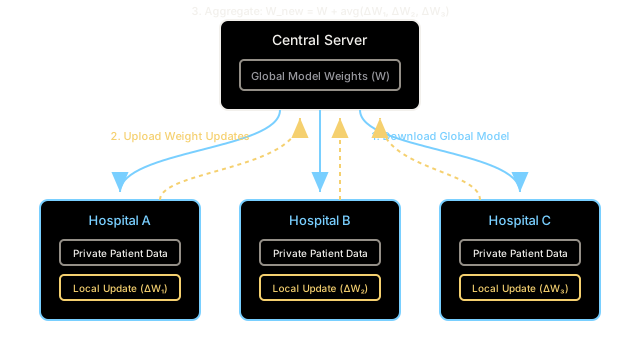
Instead of bringing private user data to a central server to train a model, federated learning brings the model to the user's device, trains it locally, and only sends the mathematical updates back to the server.
Why Does This Exist?
The traditional paradigm of machine learning is highly centralized: collect all the user data in the world, store it in a massive data center, and train a model on it.
But what if that data is incredibly sensitive? Think about the keyboard app on your smartphone that learns your typing habits, or a medical app analyzing patient X-rays across 50 different hospitals. Due to privacy laws (like HIPAA or GDPR) and basic user trust, you cannot upload everyone's private text messages or medical scans to a central server.
Federated Learning flips the paradigm. Instead of bringing the data to the model, it brings the model to the data. It allows organizations to train powerful global models on decentralized data without ever actually seeing the raw data.
Think of It Like This
Baking a cake without sharing the secret ingredients
Imagine a global baking competition where a central coordinator wants to create the perfect chocolate cake recipe.
If this were traditional machine learning, the coordinator would ask every baker to mail their secret, family-heirloom ingredients to the central kitchen. The bakers would refuse, wanting to keep their ingredients private.
In Federated Learning, the coordinator mails a draft recipe (the model) to every baker. Each baker bakes the cake in their own private kitchen using their secret ingredients. They taste it, figure out what needs to change (e.g., "needs 2g more sugar, 1g less salt"), and mail only those suggested tweaks back to the coordinator. The coordinator averages all the tweaks from thousands of bakers to update the master recipe, without ever knowing what was in anyone's private pantry.
How It Actually Works
The Federated Averaging (FedAvg) Algorithm
The most common algorithm for this process is Federated Averaging. It works in a continuous loop:
- Initialization: The central server initializes a global model and sends a copy of the weights to a subset of edge devices (e.g., 1,000 smartphones that are plugged in and connected to Wi-Fi).
- Local Training: Each smartphone uses its local, private data (like the user's text history) to perform a few steps of Gradient Descent. The model learns how to be better for that specific user.
- Weight Aggregation: The smartphones send their updated weights (or gradients) back to the central server. The raw data (the text messages) stays on the phone.
- Global Update: The central server takes the 1,000 different weight updates, averages them together, and applies them to the global model.
- Repeat: The new, smarter global model is sent back out to the next batch of phones.
Privacy vs. Security
It is crucial to understand that Federated Learning provides data privacy (the server doesn't see your raw photos), but not necessarily model security.
- Because weight updates are high-dimensional math, it is sometimes possible for an attacker sitting on the central server to use Model Inversion to reconstruct a user's data just from their weight updates.
- To prevent this, Federated Learning is almost always combined with Secure Aggregation (cryptography that ensures the server can only see the average of the updates, never an individual's update) and Differential Privacy (adding noise to the updates before sending them).
Code
# A conceptual loop of Federated Averagingdef federated_learning_round(global_model, client_devices): client_weight_updates = [] # 1. Distribute model and train locally on each device for device in client_devices: # The device downloads the current global weights local_model = download_model(global_model.weights) # The device trains strictly on its private, local data # Raw data never leaves this scope local_weights = device.train(local_model, device.private_data, epochs=3) # The device uploads the new weights to the server client_weight_updates.append(local_weights) # 2. Central server aggregates the learning # Simple averaging of all the weights new_global_weights = average_weights(client_weight_updates) global_model.update_weights(new_global_weights) return global_modelWatch Out For
Data Heterogeneity (Non-IID Data)
In a data center, you can shuffle data so every training batch is perfectly representative of the global population. In Federated Learning, data is highly skewed (Non-IID: Not Independent and Identically Distributed). One hospital might only see elderly patients; another might only see pediatric patients. If the central server just naively averages the weights, the model might fail to converge or experience "catastrophic forgetting." Researchers spend significant time designing algorithms that can handle this Non-IID data.
Stragglers and Communication Costs
Smartphones have terrible upload speeds, limited batteries, and drop off Wi-Fi constantly. A federated learning round might ask 1,000 devices to upload 50MB of weights. If 200 devices drop offline halfway through, the server has to handle the missing data gracefully (the "straggler" problem).
The Quick Version
- Federated Learning trains a centralized machine learning model without ever centralizing the raw training data.
- It works by sending the model to edge devices (phones, hospitals), training locally, and sending only the mathematical updates (gradients/weights) back to the server.
- The server aggregates these updates (usually via Federated Averaging) to improve the global model.
- It solves major regulatory and privacy hurdles, but introduces massive engineering challenges regarding unreliable networks and highly skewed, non-uniform local data.
- To be truly secure against attacks, it must be combined with cryptography and Differential Privacy.