Membership Inference
By analyzing how confidently a model predicts an output, an attacker can mathematically determine whether a specific person's data was used in the model's training set.
Why Does This Exist?
When a hospital trains a machine learning model to predict disease, they use real patient records. Once the model is trained, the hospital might release the model or offer it via an API, assuming the patient data is safely hidden inside the mathematical weights.
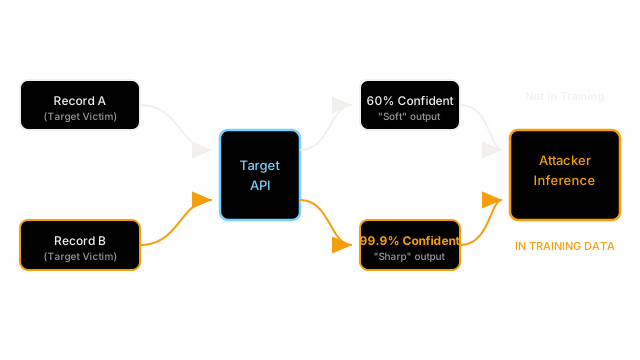
But neural networks are notorious for Overfitting. They memorize the exact details of the data they were trained on. A Membership Inference Attack (MIA) exploits this memorization. An attacker takes a specific person's medical record and asks the model for a prediction. If the model responds with extreme, unnatural confidence (e.g., 99.99%), the attacker can mathematically infer that this specific record was used in the training set.
Even if the model doesn't leak the data directly, simply confirming that a person was in the training dataset for a specific disease model is a massive privacy violation.
Think of It Like This
Asking a student a question from the textbook
Imagine a student who just took a difficult history exam.
You ask them a highly specific question: "What was the exact weather in London on the day the treaty was signed?"
If the student struggles, guesses, and says "I think it was raining," you know they are using general knowledge. But if the student instantly replies without hesitation, "It was 52 degrees and drizzling," you can infer with near certainty that this exact question was in the textbook they used to study.
Membership inference does the exact same thing to AI models. It asks a highly specific question (a data point) and uses the model's level of hesitation (confidence score) to prove whether the model studied that exact data point during training.
How It Actually Works
The Confidence Gap
Machine learning models naturally perform better on data they have seen before (training data) than on data they haven't seen (test data). This gap in performance is the root cause of Membership Inference.
When an attacker queries a model via an API, the model usually returns a probability distribution (e.g., [0.99, 0.01]).
- If a data point was in the training set, the model will likely output a very "sharp" distribution, heavily skewed toward one class.
- If a data point was not in the training set, the model will still make a prediction, but the distribution will be "softer" or more uncertain (e.g.,
[0.60, 0.40]).
Shadow Models
To execute this attack reliably, attackers often train Shadow Models.
- The attacker creates a dataset similar to the target model's dataset.
- They train several local "shadow" models on this data. Because they trained the models themselves, they know exactly which data points were "in" and which were "out."
- They record the confidence scores the shadow models produce for the "in" data and the "out" data.
- They train a simple binary classifier (the Attack Model) to look at a confidence score and predict
1(Member) or0(Non-Member). - They feed the target API's confidence scores into this Attack Model to breach the target's privacy.
Code
# A conceptual view of a Membership Inference Attackdef is_in_training_set(target_data, target_model, threshold=0.95): # The attacker queries the target model with the specific record prediction_probabilities = target_model.predict(target_data) # Get the confidence of the most likely class max_confidence = max(prediction_probabilities) # If the confidence is unnaturally high, the model likely memorized it if max_confidence >= threshold: return True # The data was likely in the training set else: return False # The data was likely unseen (not in training set)
# This simple thresholding works remarkably well on overfitted models.Watch Out For
Assuming black-box models are safe
You might think that if you only return the final hard label (e.g., "Malignant") instead of the confidence scores (e.g., "99.8% Malignant"), you are safe. While this makes MIA harder, it does not stop it. Advanced attackers can use techniques like adding slight noise to the input and counting how many times the hard label flips to estimate the model's internal confidence.
Overfitting is the primary vulnerability
The more a model overfits its training data, the more vulnerable it is to membership inference. Regularization techniques (like dropout or weight decay) help reduce this vulnerability by preventing the model from memorizing individual records, but they cannot eliminate the risk entirely without degrading model accuracy.
The Quick Version
- Membership Inference Attacks allow an adversary to determine if a specific individual's data was used to train a model.
- It exploits the fact that machine learning models are far more confident when predicting on data they memorized during training compared to unseen data.
- Attackers often train "Shadow Models" to learn exactly what an "overconfident" prediction looks like.
- It poses a severe regulatory and privacy risk, especially in healthcare, finance, and facial recognition.
- The ultimate defense against MIA is Differential Privacy, which mathematically guarantees that the inclusion of any single record will not noticeably change the model's outputs.