Multi-Task Learning
Train one shared network on several related tasks at once, so what one task teaches the shared layers can help the others, not just itself.
Why Does This Exist?
A self-driving perception system needs to detect other vehicles, segment the drivable road surface, and estimate depth from the same camera frame, all at once, on hardware with a strict compute budget. Training three completely separate networks — one per task — triples the parameter count, triples the inference cost, and, less obviously, throws away something useful: a network that's good at detecting vehicle edges has probably learned features that would also help segment road boundaries, since both tasks depend on similar low-level structure in the same images.
Multi-task learning trains one shared network on all three tasks simultaneously, so whatever the vehicle-detection gradient teaches the shared layers is available to the segmentation and depth tasks too, and vice versa — for one inference cost instead of three.
Think of It Like This
One apprenticeship covering several related trades
An apprentice training only as a carpenter learns carpentry and nothing else. An apprentice training across carpentry, plumbing, and electrical work on the same construction sites learns each trade individually, and also picks up something none of the three specialties teaches alone: how the trades interact on a real job, which is useful precisely because the three trades share a common environment.
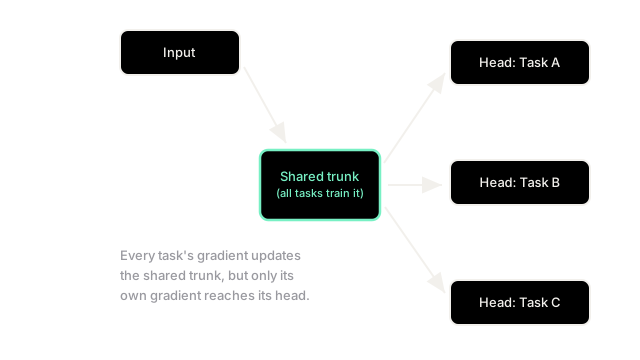
The shared context — reading a blueprint, understanding a building's structure — gets reinforced by every trade at once, while the trade-specific skills stay separate. Multi-task learning splits a network the same way: a shared trunk that every task's gradient shapes, and separate small heads that stay private to each task.
How It Actually Works
Hard parameter sharing: one trunk, several heads
The most common architecture is direct: a shared trunk of layers processes the input the same way regardless of which task is being trained on that step, and each task has its own small head attached to the trunk's output. During training, a batch belonging to task A computes task A's loss, backpropagates through task A's head and then through the shared trunk — updating the trunk based on task A's gradient. The next batch might belong to task B, and updates the same trunk again, from a different gradient. Over many steps, the trunk ends up shaped by every task's signal combined.
Why sharing helps: each task acts as a regularizer on the others
A single-task network trained on limited data can overfit to quirks specific to that dataset. A shared trunk trained across several tasks simultaneously has less freedom to fit any one task's quirks, because it also has to remain useful for the other tasks sharing it — a form of regularization that comes for free from the multi-task setup itself, not from any explicit penalty term. This is also why an auxiliary task — a secondary task added purely to help the main one, with nobody caring about its own output quality — is a standard trick: it exists only to shape the shared trunk into something more broadly useful.
Negative transfer: when tasks fight instead of help
Sharing only helps when the tasks are related enough that a representation good for one is at least somewhat good for the others. When two tasks pull the shared trunk in genuinely conflicting directions, one task's gradient step can actively undo progress the other task just made — negative transfer. This is visible directly in gradient geometry: the cosine similarity between two tasks' gradients on the shared trunk tells you whether they're pulling together or against each other. A cosine near 1 means they reinforce; a cosine near means the shared update, on average, works against at least one of them.
Task weighting: not every task deserves an equal vote
Simply summing every task's loss implicitly gives more influence to whichever task's loss happens to have a larger scale or noisier gradient — an accident of units, not a deliberate choice. In practice, each task's contribution to the combined loss is usually weighted, either by hand-tuned constants or by a scheme that adapts the weights during training based on how each task's loss is progressing, so that one loud task doesn't drown out a quieter but equally important one.
Code
Two tasks' gradients on a shared trunk, one pair aligned and one pair conflicting, and what that does to the shared update.
import numpy as np
def cosine(a: np.ndarray, b: np.ndarray) -> float: return float(a @ b / (np.linalg.norm(a) * np.linalg.norm(b)))
grad_task_a = np.array([1.0, 0.5, -0.2])grad_task_b_aligned = np.array([0.9, 0.6, -0.1])grad_task_b_conflict = np.array([-0.8, 0.2, 0.9])
for name, grad_b in (("aligned", grad_task_b_aligned), ("conflicting", grad_task_b_conflict)): shared_update = grad_task_a + grad_b print(f"{name}: cosine(A, B) = {cosine(grad_task_a, grad_b):.3f}, " f"shared update still helps A: {cosine(shared_update, grad_task_a):.3f}")# -> aligned: cosine(A, B) = 0.989, shared update still helps A: 0.997# -> conflicting: cosine(A, B) = -0.635, shared update still helps A: 0.357When the two tasks' gradients are nearly aligned, the shared update stays almost perfectly aimed at helping task A. When they conflict, the shared update's alignment with task A collapses from a perfect 1.0 down to 0.357 — a visible, measurable version of negative transfer, not just a hand-wavy concern.
Watch Out For
Assuming any two tasks sharing a trunk will help each other
Multi-task learning is a bet that the tasks are related enough for sharing to help, not a guarantee. Combining tasks that pull the shared trunk in conflicting directions can leave every task worse off than training it alone would have. Check gradient alignment between tasks, or simply compare against single-task baselines, before trusting that a multi-task setup is actually paying off.
Letting one task's loss scale dominate the combined objective
If one task's loss is naturally on a much larger numeric scale than another's — a regression loss in the hundreds next to a classification loss near 1 — an unweighted sum lets the larger-scale task dominate the shared trunk's gradient almost entirely, regardless of which task actually matters more. Weight each task's loss deliberately, and check the relative gradient magnitudes each task contributes to the shared trunk, not just the final loss numbers.
The Quick Version
- Hard parameter sharing trains one shared trunk across several tasks, with a separate small head per task, for the cost of one shared network instead of several separate ones.
- Sharing acts as a form of regularization, since the trunk has to remain useful across every task rather than overfitting to one.
- Negative transfer happens when tasks pull the shared trunk in conflicting directions, visible directly as negative cosine similarity between their gradients.
- Task weighting matters because an unweighted loss sum lets whichever task's loss has the largest scale dominate the combined gradient.