On-Device Inference
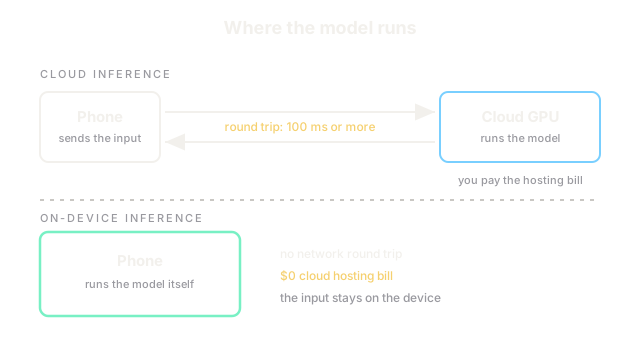
Instead of paying AWS thousands of dollars to run your model in the cloud, you compress the model and send it to the user's iPhone. The iPhone's processor does the math. Your cloud hosting cost drops to exactly $0.00.
Why Does This Exist?
In cost-per-token-engineering, we learned that generating tokens on cloud GPUs is extremely expensive. If your app has 1 million active users, your AWS bill will be astronomical.
Furthermore, in latency-budgets, we learned that sending data from a user's phone to a cloud server and back takes at least 100 milliseconds due to the speed of light and network routing. For applications like augmented reality or self-driving cars, 100ms is dangerously slow.
On-Device Inference (often called Edge AI) flips the paradigm. Instead of sending the user's data to the model in the cloud, you send the model to the user's device. The user's smartphone, laptop, or car runs the math locally using its own battery and its own processor.
Think of It Like This
Think of It Like This
Imagine you want to translate a French book into English.
Cloud Inference: You mail each page to a professional translator in Paris. You wait 3 days for the translated page to arrive in the mail, and you pay the translator $50 a page.
On-Device Inference: You download a French-to-English dictionary to your brain. You translate the page yourself instantly. It costs you no money, you don't have to wait for the mail, and nobody else ever sees what you are reading.
The Three Massive Benefits
- Zero Cloud Costs: If the user's iPhone is doing the math, you do not need to rent expensive H100 GPUs. Your server costs drop to literally zero. This is the holy grail of unit economics.
- Zero Network Latency: Because the data never leaves the device, you skip the 100ms network round-trip. The model responds instantly, and it works perfectly even if the user is in an airplane with no Wi-Fi.
- Perfect Privacy: If you are building a medical app where users analyze photos of skin lesions, sending those photos to an AWS server is a massive HIPAA liability. If the model runs entirely on the user's phone, the photo never touches the internet, guaranteeing perfect privacy.
The Brutal Hardware Constraints
If On-Device inference is so perfect, why doesn't everyone use it? Because phones are weak.
A cloud server might have 1,000 GB of RAM and pull 10,000 Watts of electricity. An iPhone has 8 GB of RAM and runs on a tiny battery. You cannot fit a 70-Billion parameter model on an iPhone.
To achieve On-Device inference, you must ruthlessly optimize the model:
- Aggressive Quantization: You must quantize the model to 4-bit (or even 2-bit) so it fits in the phone's limited memory.
- Small Base Models: You cannot use GPT-4. You must use tiny models like Llama-3 (8B), Phi-3 (3B), or Qwen (1.5B).
- Hardware Compilation: You cannot run standard PyTorch. You must compile the model using Apple's
CoreMLformat or Android'sTensorFlow Liteformat so it can run on the phone's specialized Neural Processing Unit (NPU).
Code
You don't run a Python server for On-Device inference. You embed the model directly into an iOS Swift application. First, you must convert the model to Apple's CoreML format on your laptop:
# Convert a PyTorch model to Apple CoreML format using coremltoolspip install coremltools
python -c "import coremltools as ctimport torchimport torchvision
model = torchvision.models.mobilenet_v2(pretrained=True)model.eval()example_input = torch.rand(1, 3, 224, 224)traced_model = torch.jit.trace(model, example_input)
# Convert and heavily quantize for the iPhonemlmodel = ct.convert( traced_model, inputs=[ct.TensorType(shape=example_input.shape)])mlmodel.save('MobileNet.mlpackage')"You then drag MobileNet.mlpackage into Xcode and run it natively in Swift.
Watch Out For
The Battery Drain.
When you run a neural network on a smartphone, you are pushing the processor to 100% capacity. If your app runs continuous inference (e.g., real-time video style transfer), the phone will get physically hot, and you will drain the user's entire battery in 30 minutes. Users will immediately uninstall your app. You must profile your CoreML execution to ensure it runs exclusively on the highly efficient Apple Neural Engine (ANE), not the CPU or GPU.
The Quick Version
- On-Device Inference runs the ML model directly on the user's hardware (phone, laptop, car).
- It provides perfect privacy, zero network latency, and removes cloud hosting costs entirely.
- It requires tiny models (1B to 8B parameters) and aggressive Quantization.
- You must compile the model into specialized formats like CoreML (Apple) or TFLite (Android).
- You must monitor the battery drain and thermals of the user's device carefully.