Out-of-Distribution (OOD) Detection
A model only knows the world it was trained on. OOD detection acts as a bouncer at the door, blocking completely foreign data from ever reaching the model.
Why Does This Exist?
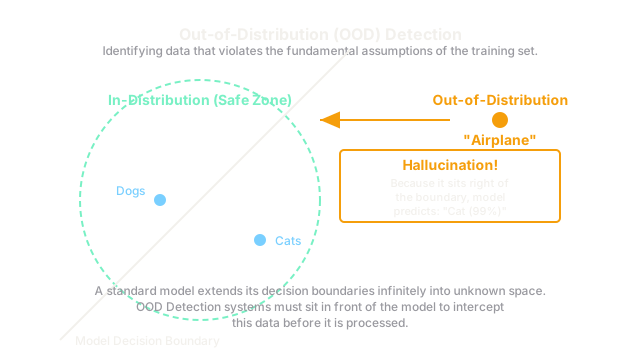
Machine learning models are mathematical optimizers. If you train a model to distinguish between Cats and Dogs, it will draw a mathematical line between them. But that line extends infinitely into mathematical space.
If you show the model a picture of an Airplane, it doesn't say, "Wait, this isn't a Cat or a Dog." It simply checks which side of the line the Airplane falls on. If the Airplane falls on the "Dog" side of the line, the model will confidently output "Dog (99%)".
This is the central danger of AI. Models are incredibly smart inside their In-Distribution (ID) safe zone, but dangerously stupid outside of it. Out-of-Distribution (OOD) Detection is the field of building secondary systems that mathematically flag data as "foreign" before the main model is allowed to make a stupid mistake.
Think of It Like This
Think of your main AI model as an expert Sommelier who only knows about Wine. If you give him a glass of Pinot Noir, he will correctly identify it. If you give him a glass of Merlot, he will correctly identify it.
But if you hand him a glass of Motor Oil (OOD data), he doesn't know what Motor Oil is. Because he is forced to act like a Sommelier, he will swirl it, smell it, and confidently declare: "This is a very thick Cabernet Sauvignon."
OOD Detection is the bouncer standing next to the Sommelier. Before the Sommelier is allowed to drink, the bouncer looks at the glass, recognizes it is black and smells like gasoline, and throws it in the trash, protecting the Sommelier from making a fatal error.
How It Actually Works
OOD Detection is notoriously difficult because you cannot train a model on "everything it isn't supposed to know." There are infinite types of OOD data. Instead, you have to build mathematical fences around the In-Distribution data.
There are three main ways to detect OOD data:
1. The Uncertainty Approach (Epistemic)
This is what we covered in deep-ensembles and monte-carlo-dropout. You pass the data to the main model, but you force the model to calculate its own Epistemic Uncertainty. If the variance is massive, you flag the data as OOD.
2. The Distance Approach (Geometry)
Before the data goes to the classification layer, it passes through the network's hidden layers as an "Embedding Vector." You calculate the mathematical center of all your training data embeddings. When a new image arrives, you calculate its embedding and measure the Mahalanobis Distance to the training center. If the distance is astronomically far, the data is OOD.
3. The Generative Approach (Reconstruction)
You train a secondary model called an Autoencoder alongside your main model. An Autoencoder's only job is to compress an image into a tiny vector, and then decompress it back into the original image.
- If you feed it a Dog (ID), it decompresses it perfectly. (Low Reconstruction Error).
- If you feed it an Airplane (OOD), the Autoencoder panics because it doesn't know how to draw wings. The output looks like garbage. (High Reconstruction Error). You use the Reconstruction Error as your OOD score. If the error is high, the bouncer rejects the data.
Code
Here is a conceptual example of the "Distance Approach" using Scikit-Learn. We fit an Isolation Forest (a type of anomaly detector) strictly on the training data.
from sklearn.ensemble import IsolationForest
# 1. Train the bouncer (OOD Detector) ONLY on your safe training data# contamination=0.01 means we assume the training data is 99% pure.ood_detector = IsolationForest(contamination=0.01)ood_detector.fit(X_train)
def safe_prediction(new_image, main_model, ood_detector): """ Evaluates new data. If it is OOD, rejects it. Otherwise, predicts. """ # 2. Ask the bouncer if this data is safe # Returns 1 for Inlier (Safe), -1 for Outlier (OOD) is_safe = ood_detector.predict([new_image])[0] if is_safe == -1: print("ALERT: Out-of-Distribution Data Detected!") return "REJECTED" else: # 3. The data is safe. Let the main model do its job. return main_model.predict([new_image])Watch Out For
Covariate Shift vs Semantic Shift
Not all OOD data is an "Airplane."
- Semantic Shift: The model was trained on Dogs/Cats, and is shown an Airplane. It should absolutely reject this.
- Covariate Shift: The model was trained on high-res photos of Dogs, but is shown a blurry, black-and-white photo of a Dog. The underlying object is still a Dog, but the pixels are Out-of-Distribution.
A bad OOD detector will reject the black-and-white dog, ruining your automation rate. Building detectors that ignore Covariate Shift but catch Semantic Shift is the hardest open problem in AI safety.
The Quick Version
- Machine learning models blindly extend their decision boundaries into infinity, causing them to confidently hallucinate when shown foreign data.
- Out-of-Distribution (OOD) Detection is a system placed in front of (or alongside) a model to intercept foreign data before it causes a hallucination.
- It can be done by measuring Model Uncertainty (Ensembles), Geometric Distance (Mahalanobis), or Reconstruction Error (Autoencoders).
- OOD detection combined with
selective-predictionforms the ultimate safety net for deploying AI into unpredictable real-world environments.