Proper Scoring Rules
A proper scoring rule is a loss function that incentivizes a model to output its true, honest probabilities rather than just guessing the most likely class.
Why Does This Exist?
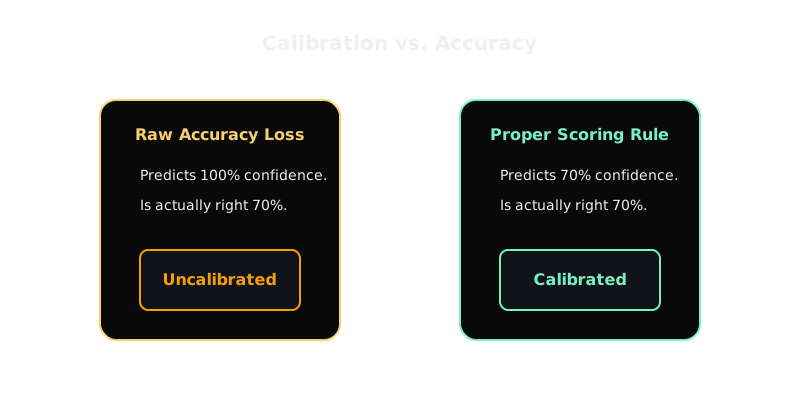
When evaluating a classification model, we often just look at accuracy: what percentage of the time did it pick the correct label? But for agentic routing or financial trading, accuracy isn't enough. We need to trust the model's confidence. If the model says it is 99% confident in a routing decision, we want it to be right exactly 99% of the time so we can safely automate it. If a model is trained only to maximize accuracy, it tends to become overconfident (predicting 100% confidence even when it's just barely guessing right). We need a mathematical way to force the model to output honest probabilities.
Think of It Like This
Imagine a sports bettor making predictions. If they are only paid for picking the winner (Accuracy), they will always say they are "100% sure" about their favorite team just to look decisive. But if the payout structure financially penalizes them for claiming 100% certainty when they were actually unsure, they will start giving honest odds like "I'm 60% confident." That payout structure is a Proper Scoring Rule.
How It Actually Works
A scoring rule is a measure of performance for probabilistic predictions. A scoring rule is strictly proper if the expected score is maximized if and only if the predicted probability distribution matches the true underlying distribution.
1. The Brier Score
The most famous proper scoring rule is the Brier Score. It simply calculates the mean squared error between the predicted probability (e.g., 0.8) and the actual outcome (1 if it happened, 0 if it didn't). Because of the squared penalty, a model that predicts 1.0 confidence and is wrong gets heavily penalized. The only mathematical way to minimize the Brier score over a dataset is to output probabilities that exactly match the base rate of correctness.
2. Log Loss (Cross Entropy)
Log Loss is also a strictly proper scoring rule. It heavily penalizes confident wrong predictions using a logarithmic scale. This is why standard neural network training with Cross Entropy loss naturally pushes models toward calibration, though modern deep networks still often require additional calibration steps.
3. Application in RLCD
In models like Laya, Reinforcement Learning with Calibrated Decisions (RLCD) is used. The model is trained using RL, but the reward function isn't just "did you get it right?". The reward is defined by strictly proper scoring rules (covering log, spherical, and ranked probability scores). Thus, the only way for the RL agent to maximize its reward is to output perfectly calibrated confidence scores.
Watch Out For
Accuracy Hides Bad Calibration A model can have 90% accuracy but terrible calibration. For example, it might predict every correct answer with 99% confidence, and every wrong answer with 99% confidence. If you try to set a confidence threshold (e.g., "only route automatically if confidence > 95%"), the uncalibrated model will confidently misroute everything. Always check the Brier score and Calibration Curves.
The Quick Version
- Accuracy only measures if the top prediction was correct.
- Proper scoring rules measure if the predicted probabilities are honest (calibrated).
- Strictly proper means the best possible score is achieved only by outputting the true probabilities.
- Brier Score and Log Loss are common proper scoring rules.
- RLCD uses these rules as reward signals in reinforcement learning to build highly trusted routing models.
What to Read Next
To see these principles applied in modern agent architectures, explore System 1 Decision Models.