Selective Prediction
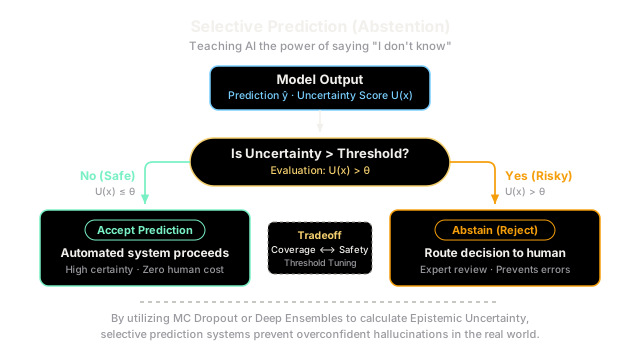
In high-stakes environments, a model shouldn't guess. Selective prediction adds a safety threshold that allows the AI to explicitly abstain from making a decision, routing the problem to a human.
Why Does This Exist?
In academia, machine learning models are evaluated by forcing them to make a prediction for every single row in a test set, and calculating their total accuracy.
In the real world (especially in medicine, finance, and autonomous driving), this is incredibly dangerous. If a medical AI doesn't know if a tumor is benign or malignant, forcing it to guess could kill a patient.
Selective Prediction (also known as Classification with a Reject Option, or Abstention) changes the fundamental architecture of an AI system. Instead of the model acting as the final authority, it acts as a filter. If the model is highly certain, it automates the decision. If the model's uncertainty exceeds a predetermined safety threshold, the model actively abstains (says "I don't know") and routes the case to a human expert.
Think of It Like This
Think of a standard ML model like a junior doctor who is terrified of looking stupid. Even if they have never seen a specific disease before, they will guess a diagnosis and prescribe medication, hoping they are right.
A Selective Prediction system trains the junior doctor to be humble. They are given a strict rule: "If you are not at least 95% sure of the diagnosis, you are not allowed to prescribe medication. You must page the senior attending physician."
By rejecting the hard cases, the junior doctor's accuracy on the remaining cases becomes near perfect.
How It Actually Works
To build a Selective Prediction system, you must have two things:
- An underlying model capable of generating a high-quality uncertainty score (e.g., using
deep-ensemblesormonte-carlo-dropout). - A mathematical framework to set the threshold.
The Accuracy-Rejection Tradeoff
Every Selective Prediction system faces a tradeoff curve.
- If you set the uncertainty threshold too loose, the model never abstains. You achieve 100% automation, but your error rate might be 15% (dangerous).
- If you set the threshold too strict, the model abstains on 99% of cases. Your error rate drops to 0%, but you have achieved 0% automation, making the AI useless.
In production, data scientists create a Risk-Coverage Curve. They sit down with business stakeholders and ask: "What is the absolute maximum error rate you will tolerate?" If the business says "1%", the data scientist slides the uncertainty threshold until the model achieves 99% accuracy on the accepted cases. At this threshold, the model might automatically handle 70% of the workload (Coverage), and route the remaining 30% to humans.
Code
Implementing Selective Prediction is a routing logic wrapper placed on top of an uncertainty estimator.
def selective_prediction_system(image, model, safety_threshold): """ Evaluates an image. If uncertainty is too high, routes to a human. Otherwise, returns the automated prediction. """ # 1. Use an ensemble or MC Dropout to get both a prediction and a variance predicted_class, uncertainty_score = model.predict_with_uncertainty(image) # 2. Check against the business-defined safety threshold if uncertainty_score > safety_threshold: # ABSTAIN! Route the image to the Human Review Queue route_to_human_expert(image, predicted_class, uncertainty_score) return "ABSTAINED - Sent to Human" else: # 3. Model is confident. Automate the decision. return predicted_class
# Example 1 (Standard Data):# output = selective_prediction_system(normal_dog_image, model, threshold=0.1)# Returns: "Dog"
# Example 2 (Out of Distribution Data):# output = selective_prediction_system(blurry_car_image, model, threshold=0.1)# Returns: "ABSTAINED - Sent to Human"Watch Out For
Threshold Drift
You cannot set an uncertainty threshold once and forget about it. As the world changes (data drift), the overall uncertainty of the incoming data will shift. If your threshold is static, your model might suddenly start rejecting 80% of its workload, flooding your human review team and crashing your operations. Thresholds must be dynamically monitored and frequently recalibrated on recent data.
The Quick Version
- Standard AI systems are forced to make a guess on every piece of data, leading to dangerous errors on data they don't understand.
- Selective Prediction systems are allowed to Abstain (say "I don't know") when their uncertainty is too high.
- These rejected cases are routed to human experts (Human-in-the-Loop).
- This creates a tradeoff: you can increase the safety (accuracy) of the AI, but only by decreasing its coverage (automation percentage).
- It is the standard operating procedure for high-stakes AI deployments in healthcare, finance, and law.