Text Summarization
The task of condensing a long document into a shorter version while preserving the core informational content and overall meaning.
Why Does This Exist?
The amount of text generated daily far exceeds human reading capacity. Whether it's legal contracts, medical journals, news articles, or endless email threads, professionals need to extract the "bottom line" quickly.
Text summarization automates this process. It takes a long input sequence and generates a short output sequence that retains the critical facts while discarding the fluff.
Think of It Like This
Think of It Like This
Imagine you are tasked with summarizing a 5-page meeting transcript. You have two ways to do it.
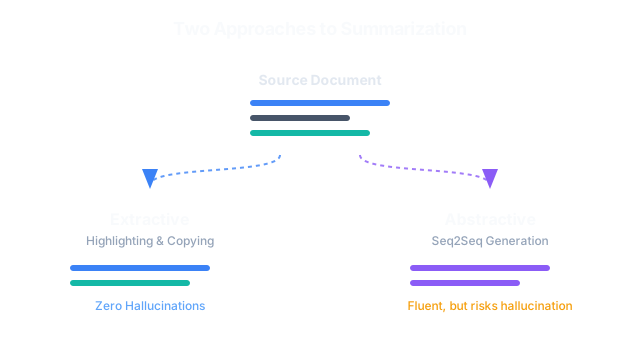
Method 1 (Extractive): You take a yellow highlighter and highlight the three most important sentences in the transcript. You copy-paste those exact three sentences onto a new piece of paper. You haven't written a single new word yourself.
Method 2 (Abstractive): You read the entire transcript, understand the key decisions that were made, put the transcript away, and write a brand new paragraph in your own words summarizing the meeting.
How It Actually Works
As the analogy suggests, there are two distinct architectures for text summarization.
1. Extractive Summarization
Extractive methods score the sentences in the original document and pick the top highest-scoring sentences to form the summary.
- Graph-based methods (TextRank): Similar to Google's PageRank, it treats every sentence as a node in a graph. Sentences that share many words (or have high cosine similarity) are connected by edges. The algorithm finds the most "central" sentences in the document and extracts them.
- Pros/Cons: Because it uses the author's original words, it is grammatically flawless and will never hallucinate false information. However, it often reads like a disjointed list of facts rather than a cohesive paragraph, and it struggles with pronoun resolution (e.g., pulling a sentence that says "He agreed to the terms" without pulling the sentence that defines who "He" is).
2. Abstractive Summarization
Abstractive methods use the exact same Encoder-Decoder (Seq2Seq) architecture as Machine Translation. Instead of translating English to French, they "translate" Long English to Short English.
- Pros/Cons: Modern Large Language Models (LLMs) excel at this. The resulting summaries are highly cohesive, flow naturally, and can compress information much tighter than extractive methods. However, because they are generating novel text, they are prone to hallucination—inventing facts that were never in the source document.
How We Measure Success
While Machine Translation uses the BLEU score, Summarization uses the ROUGE (Recall-Oriented Understudy for Gisting Evaluation) Score.
ROUGE measures how much of the human reference summary is captured by the machine summary.
- ROUGE-N: Measures the overlap of n-grams. (Did the machine use the same exact phrases as the human?)
- ROUGE-L: Measures the Longest Common Subsequence. (Did the machine capture the overall sentence structure, even if a few words were changed in the middle?)
Watch Out For
The Faithfulness Problem.
If an abstractive summarizer reads a financial report and outputs "Revenue grew by 20%", but the original document said "Revenue fell by 20%", the summary is fluent, highly readable, and catastrophically wrong. Ensuring faithfulness (that the model never hallucinates facts contrary to the source) is the single biggest open research problem in abstractive summarization today.
The Quick Version
- Text summarization condenses long documents into short summaries.
- Extractive summarization scores and copies the most important sentences directly from the source text (safe but disjointed).
- Abstractive summarization uses an Encoder-Decoder model to generate a brand new summary in its own words (fluent but prone to hallucination).
- Quality is evaluated using the ROUGE score, which measures n-gram overlap with human-written summaries.