AI for Science
Instead of humans spending decades looking through microscopes or running physics simulations, AI can learn the fundamental laws of nature directly from data, discovering new drugs and materials in days.
Why Does This Exist?
For the last 400 years, science has advanced in two main ways: experimental (doing things in a lab) and theoretical (writing math on a chalkboard). In the 20th century, a third paradigm emerged: computational science (using supercomputers to simulate physics or chemistry).
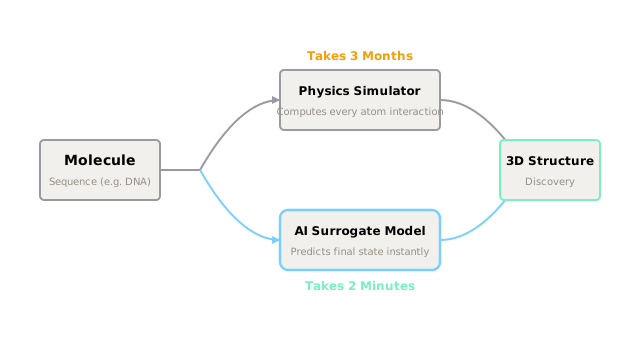
Computational simulation is incredible, but it is agonizingly slow. Simulating how a single protein folds using quantum mechanics can take a supercomputer months.
"AI for Science" is the fourth paradigm. Instead of simulating the physics step-by-step, we train a neural network on millions of past experiments. The AI learns the patterns of physics and chemistry, allowing it to predict the final result instantly without doing the math. This accelerates scientific discovery by orders of magnitude.
Think of It Like This
Imagine trying to predict where a thrown baseball will land.
Computational Science: You measure the exact wind speed, the mass of the ball, the humidity, and the angle of the throw. You plug this into a massive physics equation and calculate the trajectory microsecond by microsecond until it hits the ground. It is perfectly accurate, but takes 5 minutes to calculate.
AI for Science: You watch 10,000 people throw baseballs. When a new person throws one, you don't do any math. Your intuition just instantly knows where it will land based on pattern recognition. It takes 1 second, and it's 99% accurate.
How It Actually Works
AI is being applied across almost every scientific discipline, but two fields are currently seeing revolutionary breakthroughs: Biology and Materials Science.
1. Biology (AlphaFold)
Proteins are the building blocks of life, and their function is determined by their 3D shape. For decades, figuring out a protein's shape required years of painful laboratory work (crystallography). DeepMind's AlphaFold changed biology forever by treating amino acid sequences like a language. It uses a Transformer-based architecture to predict the exact 3D coordinates of every atom in a protein in minutes.
2. Materials Science and Drug Discovery
Finding a new battery material or a new cancer drug requires searching an almost infinite space of molecular combinations.
- Generative Chemistry: We use diffusion models (similar to DALL-E) to generate entirely new molecular structures that do not exist in nature, but possess the specific properties we want (e.g., "generate a molecule that binds to this cancer receptor but isn't toxic").
- Graph Neural Networks (GNNs): Molecules are naturally represented as graphs (atoms are nodes, bonds are edges). GNNs predict how a new molecule will behave, allowing scientists to filter out millions of dead-end chemicals before ever stepping into a lab.
Code
This conceptual snippet contrasts a traditional physics simulation with an AI surrogate model.
# --- Traditional Computational Science (Slow) ---def simulate_protein_folding(amino_acids): protein = build_initial_state(amino_acids) # Simulate quantum interactions for 10 million femtosecond steps for step in range(10_000_000): forces = calculate_quantum_forces(protein) protein.update_positions(forces) return protein.final_3d_structure() # Takes 3 months to run
# --- AI for Science (Fast) ---def predict_protein_folding(amino_acids, ai_model): # Convert amino acids into a sequence of tokens tokens = tokenize(amino_acids) # The neural network predicts the final 3D coordinates instantly # based on patterns it learned during training. predicted_3d_structure = ai_model.predict(tokens) return predicted_3d_structure # Takes 2 minutes to runWatch Out For
The Out-of-Distribution Problem
AI models can only predict things similar to what they have seen in training. If you train a model on Earth-based chemistry, and ask it to predict how materials behave inside a neutron star, it will hallucinate wildly. It does not actually know physics; it only knows patterns.
Experimental Validation
An AI can invent a cure for cancer on a computer, but it might be impossible to physically synthesize in a lab, or it might have unexpected side effects in the human body. The bottleneck in science is shifting from "discovering ideas" to "physically testing the AI's ideas in a wet lab."
The Quick Version
- AI for Science replaces slow, traditional physics simulations with fast, pattern-matching neural networks.
- It has already revolutionized structural biology (e.g., AlphaFold predicting protein structures).
- Generative models are now used to invent new drugs and materials that do not exist in nature.
- While AI accelerates the theoretical discovery phase, every AI prediction must still be physically validated in a laboratory.