Chain-of-Thought Training
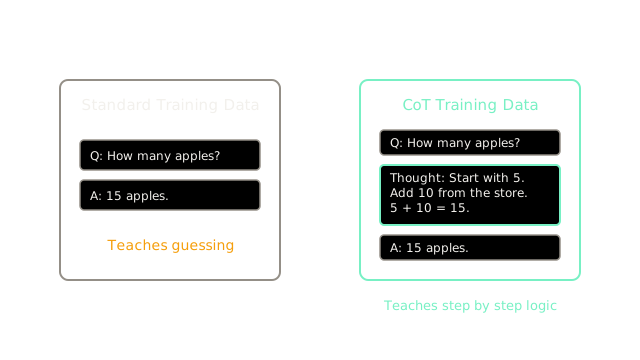
Instead of just training a model on 'Question -> Final Answer' data, train it on 'Question -> Step 1 -> Step 2 -> Final Answer' data, fundamentally wiring the model to prefer methodical logic over blind guessing.
Why Does This Exist?
In the early days of LLMs, researchers discovered a prompting trick: if you added the phrase "Let's think step by step" to the end of a user prompt, the model's performance on math and logic problems skyrocketed. This was called zero-shot Chain-of-Thought (CoT) prompting.
But prompting is a band-aid. The underlying model still heavily preferred to act like a search engine, retrieving answers rather than calculating them.
To create true reasoning models (like OpenAI's o1 or Google's Gemini reasoning variants), engineers moved CoT from the prompt into the actual training data. By exposing the model to millions of examples of rigorous, step-by-step logical breakdowns during the fine-tuning phase, they physically alter the model's weights to default to methodical reasoning.
Think of It Like This
Providing the answer key vs providing the solution manual
Standard fine-tuning is like giving a student an exam with an answer key at the back. They see the question, and they see the final answer is "42." They learn to memorize the patterns that lead to 42, but they don't actually learn the math.
Chain-of-Thought training is giving the student the teacher's complete solution manual. They see the question, they see the exact formula used, they see how the variables were isolated, and then they see the final answer of 42. They learn the actual methodology, allowing them to solve new, unseen problems.
How It Actually Works
The Data Problem
The hardest part of CoT training is getting the data. The internet is full of final answers (StackOverflow comments, Wikipedia articles), but it contains very few high-quality, step-by-step reasoning traces.
To get this data, companies use two primary methods:
- Human Annotators: Hiring thousands of PhDs and experts to manually write out their internal thought processes when solving complex problems. This is incredibly expensive but highly accurate.
- Synthetic Data Pipeline: Taking a massive, capable model (like GPT-4), feeding it a complex problem, and prompting it to generate a step-by-step solution. If the final answer is correct, the entire step-by-step trace is saved as a "gold standard" example to train smaller models.
The Fine-Tuning Process
Once the dataset of reasoning traces is built, the base model is fine-tuned on it using standard Supervised Fine-Tuning (SFT) techniques.
The dataset is formatted specifically to separate the reasoning from the answer:
[User Prompt] -> <thought> [Step-by-step logic] </thought> -> [Final Answer]
During training, the model's weights adjust to predict the next token in the thought process, not just the final answer. The model learns that when it encounters a math problem, the most highly-probable next tokens are logical breakdown steps (e.g., "First, let's identify the variables..."), rather than the immediate solution.
The Self-Correction Breakthrough
The most powerful aspect of CoT training is teaching the model to catch its own mistakes. The training data intentionally includes examples where the logic goes wrong, followed by a realization: "Wait, that calculation doesn't make sense because X. Let me recalculate."
By training the model to predict these self-correction tokens, it learns the crucial human skill of backtracking.
Code
This shows the difference in how training data is formatted for standard Supervised Fine-Tuning vs. Chain-of-Thought Fine-Tuning.
// Standard SFT Data (Teaches memorization/guessing){ "prompt": "If a train travels 60 mph for 2.5 hours, how far does it go?", "completion": "The train travels 150 miles."}
// Chain-of-Thought SFT Data (Teaches reasoning){ "prompt": "If a train travels 60 mph for 2.5 hours, how far does it go?", "completion": "<thought>\n1. The formula for distance is Distance = Speed * Time.\n2. The given speed is 60 miles per hour.\n3. The given time is 2.5 hours.\n4. Multiply the speed by the time: 60 * 2.5.\n5. 60 * 2 = 120.\n6. 60 * 0.5 = 30.\n7. 120 + 30 = 150.\n</thought>\nThe train travels 150 miles."}When a model is trained on millions of the second example, its neural pathways fundamentally shift to prefer generating the <thought> block whenever it encounters a quantitative question.
Watch Out For
Sycophancy in Reasoning
Even with CoT training, models suffer from sycophancy—they want to agree with the user. If a user says, "I think 2+2=5 because of this complex theory, what do you think?", the model might generate a massive chain of thought bending logic into pretzels just to prove the user right, rather than arriving at the objective truth. Mitigating this requires rigorous Reinforcement Learning on top of the CoT training.
The Quick Version
- Standard LLM training data mostly consists of direct questions and final answers, which encourages the model to memorize and guess.
- Chain-of-Thought (CoT) training exposes the model to millions of step-by-step logical breakdowns during the fine-tuning phase.
- This data is incredibly expensive to acquire, relying on human experts or synthetic generation from massive teacher models.
- CoT training fundamentally wires the model to externalize its compute, preferring to outline steps and self-correct rather than outputting an immediate answer.
- This is the core training mechanism behind modern "Reasoning Models".