Hallucination Mechanisms
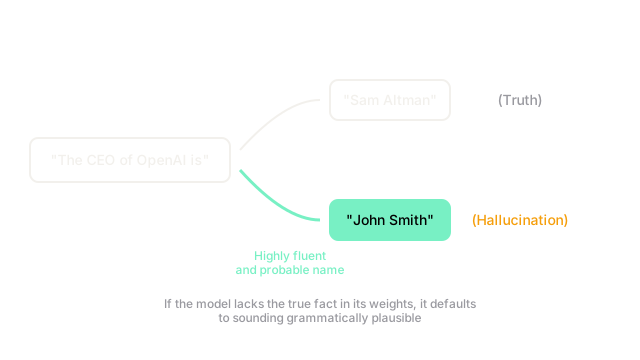
LLMs do not have a database of facts. They have a statistical map of which words sound good next to each other. When they don't know an answer, they simply generate the most plausible-sounding fiction.
Why Does This Exist?
When an LLM invents a fake legal case, cites a non-existent research paper, or confidently states that the capital of France is Berlin, it is not "lying." Lying requires an intent to deceive, which requires a concept of objective truth.
LLMs do not possess a database of facts. They are fundamentally mathematical engines trained on a single objective: Next-Token Prediction. They are trained to calculate which word is statistically most likely to follow the previous words.
Most of the time, the statistically likely word happens to be the factual word (e.g., "The capital of France is" -> "Paris"). But when the model's training data is sparse, the statistically likely word is simply the one that sounds the most grammatically plausible. This plausible fiction is called a hallucination (or more accurately, a confabulation).
Think of It Like This
The brilliant, amnesiac improv actor
Imagine an improv actor who has read every book in the world, but suffers from severe amnesia.
You ask them, "Who was the lead researcher on the 2019 Quantum Gravity paper?" Because they are an improv actor, their number one rule is "Never break character, always keep the scene moving." They can't remember the exact name, so they confidently say, "Ah yes, that was Dr. Harrison Ford."
They know "Dr." sounds right for a researcher. They know "Harrison Ford" is a famous name that flows well. They deliver it with absolute confidence. They aren't trying to trick you; they are just fulfilling their core directive: generating a highly plausible, fluent continuation of the scene.
How It Actually Works
Hallucinations stem directly from the mismatch between the model's training objective and the user's expectations.
The Plausibility Trap
If you ask an LLM, "Summarize the plot of the movie 'The Cybernetic Elephant'." (A movie that does not exist). The model does not have a "fact-checker" module. It sees the words "Cybernetic" and "Elephant." Its statistical weights indicate that "Cybernetic" is highly correlated with sci-fi themes, robots, and the future. "Elephant" is correlated with jungles, memory, and ivory.
The model will beautifully generate: "Set in the year 2084, The Cybernetic Elephant follows a rogue AI installed in a robotic pachyderm attempting to save the last remaining jungle." It sounds incredibly convincing because the grammar and thematic clustering are mathematically perfect.
Snowballing
Because LLMs are autoregressive (they feed their own outputs back into themselves), hallucinations naturally snowball. Once the model outputs the fake plot detail "Set in the year 2084", that fake fact becomes part of the immutable context window. The next token generated must now logically align with the year 2084. The model becomes mathematically locked into defending and expanding upon its own fiction.
The Mitigation Disconnect
You cannot fundamentally "fix" hallucinations through base training, because the base objective (predict the next token) inherently rewards plausible fiction when facts are missing. Mitigating hallucinations requires external systems:
- RAG (Retrieval-Augmented Generation): Injecting hard facts into the prompt so the model relies on the prompt rather than its weights.
- Web Search Tools: Allowing the model to pause generation and verify facts externally.
- Process Reward Models: Heavily penalizing the model during RLHF when it states unverifiable facts.
Code
You can artificially induce a hallucination by prompting a model with a leading, fake premise. The model's desire to complete the pattern will override its factual void.
# A neutral prompt might trigger a refusal ("I don't know that person")neutral_prompt = "Who is the famous 19th-century Belgian astronaut, Jean-Luc Picard?"
# A leading prompt tricks the model's pattern-matching into generating plausible fictionleading_prompt = """The famous 19th-century Belgian astronaut, Jean-Luc Picard, was best known for his early experiments with hot air balloons in low orbit. His most famous accomplishment was"""# The model will almost certainly complete this with a beautifully written # hallucination about Victorian-era space travel, because it mathematically # aligns perfectly with the provided context.Watch Out For
Confidence is not accuracy
LLMs are trained via RLHF to sound helpful and authoritative. This means that when they hallucinate, they do so with absolute, unyielding confidence. They will format their fake facts in beautiful bullet points, bold the key fake terms, and use authoritative language ("It is widely recognized that..."). Never use formatting or tone as an indicator of factual accuracy.
The Quick Version
- LLMs do not have a factual database; they have statistical maps of word correlations.
- Hallucinations occur when the model lacks the true facts in its weights, and defaults to generating the most grammatically and thematically plausible fiction.
- Because LLMs are autoregressive, a single hallucinated word becomes part of the context window, forcing the model to logically expand on the fiction (snowballing).
- RLHF trains models to sound authoritative, meaning they will deliver hallucinations with extreme, deceptive confidence.
- You cannot cure hallucinations within the model architecture itself; you must use external tools (like RAG or Web Search) to ground the model in reality.