LLM-as-a-Judge
Using a powerful language model to automatically grade the open-ended outputs of another model, serving as a scalable proxy for human evaluation.
Why Does This Exist?
In classical machine learning, evaluation is mathematically trivial. If the model outputs Dog and the ground truth is Dog, the model gets a 1. If it outputs Cat, it gets a 0. You can grade a billion predictions in a fraction of a second.
Generative AI destroys this paradigm. If you ask an LLM to "Write a polite email declining a job offer," there are millions of valid ways to write that email. There is no single ground truth string to compute an exact match against.
Initially, the only way to evaluate open-ended generation was to hire humans to read the outputs and score them. This is exceptionally slow, extremely expensive, and difficult to reproduce, meaning you cannot run a human evaluation suite on every pull request. The solution is LLM-as-a-Judge: using a larger, more capable model (like GPT-4 or Claude 3.5 Sonnet) to read the output of a smaller model and grade it according to a strict rubric. It provides the nuance of human evaluation at the speed and cost of an automated script.
Think of It Like This
Think of LLM-as-a-Judge like a university grading system.
If a professor assigns a multiple-choice test, a machine can grade the Scantron sheets instantly (classical exact-match evaluation).
But if the professor assigns a 10-page essay on the Roman Empire, a Scantron machine is useless. The professor must hire teaching assistants (human evaluators) to read the essays and grade them against a rubric. LLM-as-a-Judge is the equivalent of inventing a robotic teaching assistant that can read a thousand essays a minute, applying the professor's exact grading rubric to each one tirelessly.
How It Actually Works
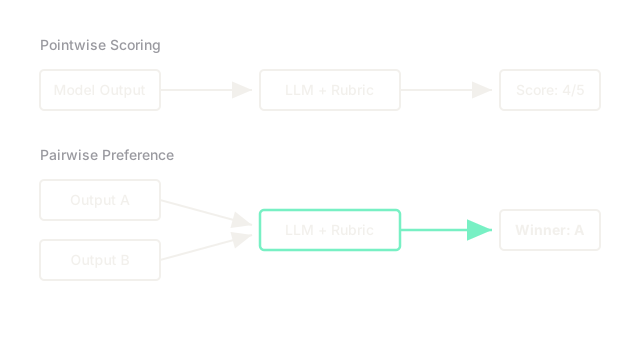
Implementing an LLM judge requires designing a strict prompt that acts as the grading rubric. There are two primary architectures for these evaluations: Pointwise and Pairwise.
1. Pointwise Scoring
In pointwise evaluation, the judge looks at a single model's output in isolation and assigns it an absolute score (e.g., 1 to 5) based on a rubric.
The Prompt Structure:
- The Input: The original question asked by the user.
- The Output: The text generated by the model under test.
- The Rubric: Detailed instructions defining what a 1 means, what a 3 means, and what a 5 means.
- The Output Format: Instructions forcing the judge to output its reasoning first, followed by a final integer score (e.g.,
Score: 4).
Pointwise scoring is useful because you can easily track a model's absolute quality over time. However, LLMs struggle to maintain consistent absolute scales; a 4 out of 5 today might have been a 3 last week depending on minor prompt variations.
2. Pairwise Preference
In pairwise evaluation, the judge looks at the outputs from two different models side-by-side and declares a winner.
The Prompt Structure:
- The Input: The original question.
- Output A: The generation from the baseline model.
- Output B: The generation from the new model.
- The Task: "Which output is better? Output A, Output B, or Tie?"
Pairwise preference is significantly more reliable than pointwise scoring. It is much easier for an LLM (and a human) to say "A is better than B" than to decide if an output deserves an arbitrary 3 or a 4 on an absolute scale. This pairwise data is often used to compute Elo ratings for models, similar to chess rankings.
3. Reasoning Before Scoring
A critical mechanism in both approaches is forcing the judge to explain itself before it emits the final score. LLMs do not possess hidden thoughts; their computation happens as they generate tokens. If you force the judge to output the score as the first token, it has no time to "think" about the text. By prompting the judge to write a paragraph of critique first, you force it to allocate compute to the problem, resulting in drastically more accurate final scores.
Code
Here is how you might structure a pointwise judge prompt and parse the result. Note the strict rubric and the requirement to reason before scoring.
import re
def create_judge_prompt(question: str, model_output: str) -> str: return f""" You are an expert evaluator grading an AI assistant. User Question: {question} Assistant Output: {model_output} Rubric: 1 - The output is completely wrong, unsafe, or irrelevant. 3 - The output is partially correct but misses nuance or has minor errors. 5 - The output is perfectly accurate, helpful, and well-formatted. First, write a brief critique of the assistant's output, explaining how it aligns with the rubric. Finally, on a new line, output exactly: "Score: [1/2/3/4/5]" """
def parse_judge_score(judge_response: str) -> int: """Extracts the final integer score from the judge's reasoning text.""" match = re.search(r"Score:\s*([1-5])", judge_response) if match: return int(match.group(1)) else: raise ValueError("Judge failed to output a valid score.")
# judge_response = "... Therefore, it earns a high mark.\nScore: 4"# -> parse_judge_score(judge_response) -> 4Watch Out For
The Agreement Trap
Do not blindly trust an LLM judge without validating it against human graders. A standard practice is to have humans grade 100 examples, have the LLM judge grade the exact same 100 examples, and calculate their agreement rate. If the LLM judge agrees with the humans 85% of the time, you can confidently replace the humans with the LLM. If the agreement is 50%, your judge is effectively rolling a die, and your rubric needs a rewrite.
Self-Enhancement Bias
Models notoriously prefer their own writing style. If you use GPT-4 as a judge, it will systematically assign higher scores to outputs generated by GPT-4 than to identically good outputs generated by Claude or Llama. This bias must be accounted for if you are using LLM-as-a-judge to compare competing foundational models.
The Quick Version
- Evaluating open-ended generative AI cannot be done with classical exact-match metrics.
- LLM-as-a-Judge uses a powerful foundational model to grade the outputs of other models based on a strict prompt rubric.
- Pointwise scoring asks the judge to assign an absolute number (e.g., 1 to 5) to a single output.
- Pairwise preference asks the judge to read two outputs side-by-side and declare a winner, which is generally more robust and reliable.
- Always force the judge to write out its reasoning before emitting the final score, as this forces the model to compute the nuances of the rubric.