Memory-Augmented Architectures
Instead of trying to memorize the entire internet inside its neural weights, what if an AI had a searchable, external hard drive it could read and write to?
Why Does This Exist?
Standard Large Language Models (like GPT-4) store all their knowledge implicitly inside their neural weights (matrices of billions of numbers). This has three major flaws:
- Inefficiency: Storing facts in weights requires massive models. You don't need a 100B parameter model to do basic math, but you do need it to memorize the capital of every country.
- Hallucination: If the model's weights don't perfectly encode a fact, it just guesses, outputting highly confident nonsense.
- Static Knowledge: You cannot easily update or delete a specific fact. If a CEO changes, you have to retrain or fine-tune the model to update the weights.
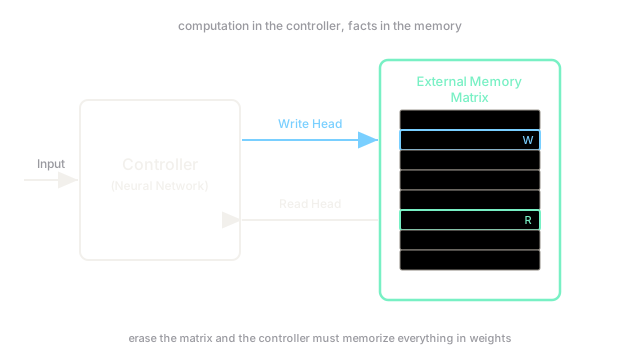
Memory-Augmented Architectures solve this by decoupling computation (the neural network) from storage (an external memory matrix). The network learns how to process information, and it reads/writes specific facts to the external memory bank.
Think of It Like This
Imagine a student taking an open-book math exam.
A Standard LLM: The student was forced to memorize the entire textbook, put the book away, and take the test from memory. If they forget a formula, they guess.
A Memory-Augmented Model: The student brings the textbook and a notebook into the exam. The student's brain (the neural network) only needs to know how to do math and how to look up formulas in the book (the memory bank). If the teacher issues a correction to a formula, the student just scratches it out in the notebook and writes the new one; they don't need to relearn math.
How It Actually Works
The concept originated with the Neural Turing Machine (NTM) and evolved into architectures like the Differentiable Neural Computer (DNC).
The Controller and the Memory Matrix
The system consists of a "Controller" (a standard neural network, like an LSTM or Transformer) and a "Memory Matrix" (a 2D grid of numbers, like RAM in a standard computer).
Differentiable Read/Write Heads
In a standard computer, a CPU reads data from a specific, discrete address in RAM (e.g., Read address 0x004). Neural networks, however, require everything to be continuous (differentiable) so they can be trained via backpropagation.
Instead of reading a single address, a Memory-Augmented Model uses an "Attention" mechanism to read every address simultaneously, but to varying degrees.
- The Controller emits a "Key" vector (e.g., representing the concept "Capital of France").
- It compares this Key to every slot in the Memory Matrix.
- It pulls data strongly from slots that match, and ignores slots that don't match.
- Crucially, it also has a Write Head that allows it to erase old memory slots and write new vectors into them during a task.
How is this different from RAG?
Retrieval-Augmented Generation (RAG) is a macro-level version of this. In RAG, you pull text chunks from a database and paste them into the LLM's prompt. In a true Memory-Augmented Architecture, the memory interaction happens at the micro-level, inside the layers of the network itself. The network learns its own proprietary latent language for what to store in the memory matrix, making it much faster and more integrated than pasting English text into a prompt.
Code
This conceptual code shows how a controller reads from an external memory matrix using content-based addressing.
import torchimport torch.nn.functional as F
class MemoryReadHead: def __init__(self, memory_matrix): # memory_matrix shape: [num_slots, slot_size] self.memory = memory_matrix def read(self, query_vector): """ The network doesn't provide a hard integer address. It provides a query vector, and we use cosine similarity to find the best match. """ # 1. Compare the query to all memory slots similarity_scores = F.cosine_similarity(query_vector.unsqueeze(0), self.memory) # 2. Convert similarities into a probability distribution (Attention) attention_weights = F.softmax(similarity_scores, dim=0) # 3. The output is a weighted sum of the entire memory matrix # (It pulls heavily from the slots that matched the query) retrieved_data = torch.sum(attention_weights.unsqueeze(1) * self.memory, dim=0) return retrieved_dataWatch Out For
Training Instability
Training a model to use read/write heads is notoriously difficult. Early in training, the memory matrix is random noise, so the controller gets garbage data back and learns to ignore the memory entirely. Researchers have to use curriculum learning to slowly force the model to rely on the memory.
Scaling Bottlenecks
Because the read/write mechanism calculates attention across every slot in memory at every time step, scaling the memory matrix to hold billions of facts requires or compute. Modern research focuses on using sparse approximations (like approximate nearest neighbors) so the model only checks a fraction of the memory.
The Quick Version
- Standard neural networks store facts inefficiently by burning them into their computational weights.
- Memory-Augmented Architectures separate the neural network (the Controller) from the data (an external Memory Matrix).
- The network uses differentiable Read/Write heads to query and update the memory matrix dynamically during a task.
- This allows models to be much smaller (since they don't need to memorize everything) and allows developers to update the model's knowledge instantly just by overwriting the external memory.