Neurosymbolic AI
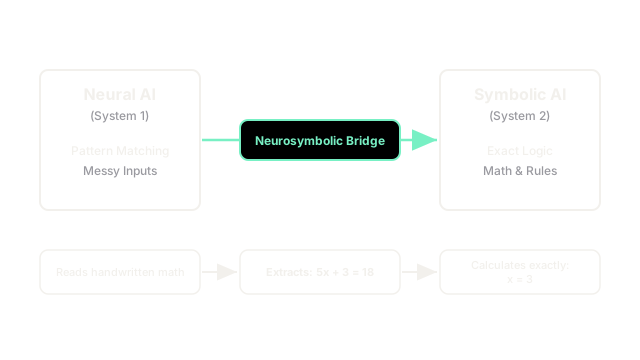
Neural networks are great at intuition and pattern matching, but terrible at logic and math. Symbolic AI is perfect at logic and math, but terrible at intuition. Neurosymbolic AI combines them to get the best of both worlds.
Why Does This Exist?
In the history of Artificial Intelligence, there have been two distinct paradigms:
- Symbolic AI (Good Old-Fashioned AI): This dominated from the 1950s to the 1990s. It relies on hard-coded rules and logic (e.g., "If A > B, then C"). It is 100% mathematically verifiable, perfectly interpretable, and terrible at handling the messy real world (like recognizing a face).
- Neural AI (Deep Learning): This dominates today. It relies on learning statistical patterns from massive datasets. It is incredibly good at messy, fuzzy problems (like recognizing a face), but it cannot reliably do basic arithmetic or formal logic. It operates on statistical probability, not absolute truth.
Neurosymbolic AI exists because scaling up Neural AI (just making LLMs bigger) will not magically teach them perfect mathematical logic. To achieve Artificial General Intelligence (AGI), an AI needs both the "intuition" of neural networks and the "rigor" of symbolic engines.
Think of It Like This
Psychologist Daniel Kahneman describes human thinking as having two systems.
System 1 (Neural AI): Fast, automatic, and intuitive. When you see a picture of an angry dog, you instantly know to back away. You don't calculate it; you just know it.
System 2 (Symbolic AI): Slow, deliberate, and logical. When asked to solve , you cannot just feel the answer. You have to stop, apply a rigid set of mathematical rules, and compute it step-by-step.
Standard LLMs only have System 1. Neurosymbolic AI attempts to give them a System 2.
How It Actually Works
Neurosymbolic AI is a broad umbrella term, but most modern implementations fall into one of two architectures:
1. Neural Symbolic (Perception to Logic)
The neural network acts as the eyes and ears, translating messy real-world data into clean, structured symbols. The symbolic engine then takes those symbols and performs guaranteed logical reasoning. Example: You show the AI a messy, hand-drawn picture of a geometry problem. The Neural Network (Vision Model) looks at the pixels and extracts the structured facts: "Triangle ABC. Angle A is 45 degrees." It hands these facts to a Symbolic Math Engine (like SymPy or Wolfram Alpha), which perfectly calculates the remaining angles.
2. Symbolic Neural (Rules guiding Learning)
The symbolic engine acts as a strict supervisor, forcing the neural network to obey the laws of physics or logic during training. Example: You are training a neural network to control a drone. You write a strict symbolic rule: "Velocity must never exceed 50 m/s." During training, if the neural network predicts an action that would violate this symbolic rule, the symbolic engine overrides it and heavily penalizes the network. The neural network learns the fuzzy, complex aerodynamics, but is mathematically constrained by the hard rules.
Code
This conceptual code demonstrates the Neural Symbolic pipeline using an LLM to extract facts for a logical solver.
def neurosymbolic_pipeline(user_query): # 1. The Neural System (LLM) handles the messy, ambiguous human language # It extracts the mathematical variables and operators. structured_formula = llm.extract_math( query=user_query, prompt="Extract the math equation into a machine-readable string." ) # Output: "solve_for_x(2*x + 5 = 15)" # 2. The Symbolic System (e.g., SymPy) handles the rigorous computation # It cannot hallucinate; it applies exact algebraic rules. try: exact_answer = symbolic_math_engine.solve(structured_formula) # Output: x = 5 return f"The exact answer is {exact_answer}" except SyntaxError: return "Neural extraction failed to produce valid symbols."
# The LLM doesn't try to guess the answer. It just translates the problem # into a format the calculator understands.Watch Out For
The Translation Bottleneck
The hardest part of Neurosymbolic AI is the handoff. If the Neural Network extracts the wrong symbol (e.g., it sees a '+' but extracts a '-'), the Symbolic Engine will execute the wrong logic perfectly, resulting in a confident, catastrophically wrong answer.
Differentiability
Neural networks learn via backpropagation, which requires every step in the pipeline to be mathematically differentiable (smooth). Traditional symbolic logic engines (like 'If/Else' statements) are discrete, meaning gradients cannot flow through them. Bridging this gap requires complex mathematical workarounds.
The Quick Version
- Neural AI (Deep Learning) is great at pattern recognition but terrible at rigid logic and math.
- Symbolic AI is perfect at logic and math but cannot handle messy, unstructured real-world data.
- Neurosymbolic AI combines both. The neural network handles perception and intuition, while the symbolic engine handles rigorous, verifiable reasoning.
- This hybrid approach is widely considered necessary for AI to move past statistical guessing and achieve true reasoning (System 2 thinking).