Simulation and Sim-to-Real
You can't train a self-driving car by letting it crash 10,000 times on a real highway. You have to train its brain in a video game, then carefully transfer that brain into a real car without it realizing the physics changed.
Why Does This Exist?
Reinforcement Learning (RL) algorithms are incredibly data-hungry and sample-inefficient. An RL agent might need to try walking and fall over millions of times before it learns to balance.
If you try to do this with a physical $100,000 robot, the robot will wear out its joints, break its chassis, or hurt a researcher long before it learns to walk. Training in the real world also runs in real-time. Training in a physics simulator (like Isaac Sim, MuJoCo, or PyBullet) can be run on 1,000 GPUs simultaneously, simulating years of experience in a single afternoon. Therefore, almost all modern robot learning happens in simulation. The challenge is that simulators are not perfect copies of reality, leading to the Sim-to-Real gap.
Think of It Like This
Imagine training an elite athlete using only a virtual reality game.
In the VR game, gravity is exactly 9.8 m/s², the floor is perfectly flat, and the air resistance is zero. The athlete becomes the world champion of the VR game.
Then you put the athlete in a real track-and-field stadium. It's windy. The rubber track has slight imperfections. The gravity is 9.806 m/s². The athlete instantly trips and falls, because they overfit to the perfect, sterile math of the VR game. Bridging the Sim-to-Real gap is about making the VR training so deliberately messy that the real world just feels like another minor variation.
How It Actually Works
The central problem of Sim-to-Real is that if a neural network finds a way to exploit a tiny physics glitch in the simulator (e.g., vibrating a leg at a specific frequency causes the robot to glide forward without walking), it will use it. When deployed on physical hardware, that glitch doesn't exist, and the policy fails catastrophically.
Researchers use several techniques to force the model to learn true physics rather than simulator quirks.
1. Domain Randomization (The Standard Approach)
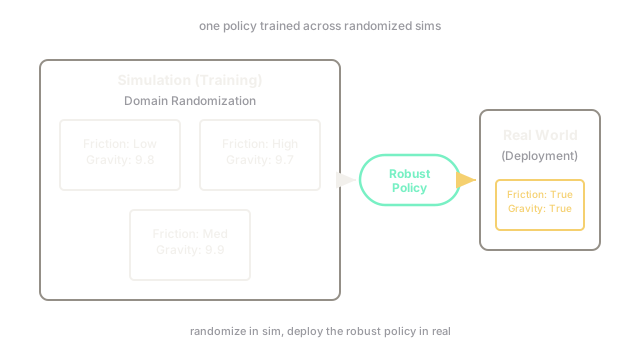
Instead of trying to make the simulation a perfect copy of reality, you make it wildly random. During training, you constantly randomize the physical parameters of the simulation:
- Mass: Make the robot's arm 10% heavier, then 5% lighter.
- Friction: Make the floor slippery like ice, then sticky like rubber.
- Lighting and Textures: Change the colors and camera noise so the vision model doesn't overfit to specific pixel values.
Because the AI cannot rely on exact, perfect physics, it is forced to learn a robust, generalized policy. When it is finally deployed in the real world, the real world just looks like one more randomized environment, and the policy succeeds.
2. System Identification
This is the opposite of randomization. You use real-world data to perfectly tune the simulator parameters to match the specific physical robot. If the real robot's left motor is slightly weaker than the right, you explicitly model that asymmetry in the simulator.
3. Sim-to-Real-to-Sim (Closing the Loop)
You train in simulation, deploy in the real world, and record where the real robot fails. You use that real-world failure data to update the simulation parameters, then retrain. This creates a "digital twin" that gets closer to reality over time.
Code
This snippet demonstrates setting up Domain Randomization in a theoretical physics simulator.
import random
def get_randomized_environment(): """ Instead of a static environment, we spawn an environment where the physical constants are randomized within a realistic range. """ env = Simulator.create_environment() # Base friction is 1.0. We randomize between 0.5 (slippery) and 1.5 (sticky) friction_coefficient = random.uniform(0.5, 1.5) env.set_ground_friction(friction_coefficient) # Base mass is 5kg. We randomize +/- 20% base_mass = 5.0 randomized_mass = base_mass * random.uniform(0.8, 1.2) env.set_robot_mass(randomized_mass) # Add noise to the camera sensor camera_noise_level = random.uniform(0.0, 0.1) env.add_sensor_noise(camera_noise_level) return env
def train_sim_to_real_agent(agent, epochs=1000): for epoch in range(epochs): # Every episode is run in a slightly different universe env = get_randomized_environment() agent.train_one_episode(env) return "Agent is ready for zero-shot transfer to reality"Watch Out For
The Reality Gap is unclosable
No simulator can perfectly model complex phenomena like fluid dynamics, soft-body deformation (like handling cloth or dough), or complex friction (like a tire skidding on gravel). For these tasks, domain randomization often fails, and you must use real-world teleoperation data.
Over-randomization
If you randomize the physics too much, the task becomes mathematically impossible to solve. The neural network will fail to converge on any policy because the environment is pure chaos. The art of Domain Randomization is bounding the randomness just enough to cover reality, but no more.
The Quick Version
- Training robots in the real world is slow, dangerous, and expensive. Training in physics simulators is fast, safe, and parallelizable.
- The "Sim-to-Real gap" occurs because simulators are imperfect; an AI that learns in a simulator will often fail in reality because it overfits to the simulator's specific math.
- Domain Randomization solves this by randomizing gravity, friction, mass, and lighting during training.
- By forcing the AI to succeed across thousands of varying physical conditions, the real world becomes just another variation that the robust policy can handle.