System Prompts & Personas
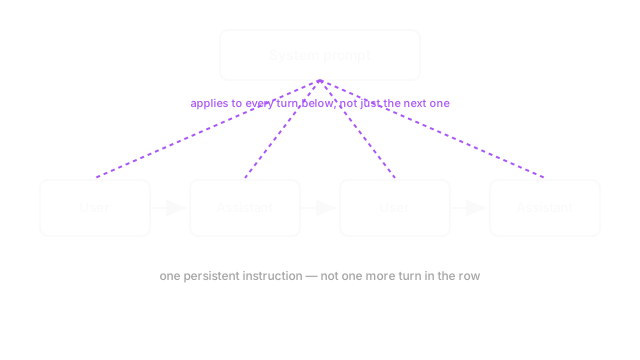
A system prompt is a standing instruction set placed ahead of the conversation once, so the model treats it as a persistent rule, not a message to reread.
Why Does This Exist?
Say you're building a coding assistant. You want it terse, code-first, no unsolicited caveats, bound by a couple of hard rules: never invent an API that doesn't exist, always show a runnable snippet. Without something to carry that intent, you'd have to restate it at the top of every message, and the model would have no reason to treat message twelve's restated instructions as more binding than message twelve's actual question.
That's the gap a system prompt closes. It's a block of instructions you set once, before the conversation starts, describing who the model is being right now and what it must never do. The API sends it in a slot separate from the back-and-forth of user and assistant turns, and most providers tune their models to give that slot outsized weight — not just more text to skim, but a standing directive the rest of the conversation operates inside of.
Contrast two versions of that assistant. One has a system prompt fixing its persona and rules. Ask it for a rate limiter in message one and a database migration script in message nine, and it stays terse, still shows working code, still refuses to hallucinate a method that doesn't exist on your library. The other has no system prompt — just a plain chat. Early on it might happen to be terse because you asked a terse question. A few turns later, after some small talk, it drifts: hedges creep in, it explains things you didn't ask about, and nothing stops that because nothing was ever fixed to begin with.
Think of It Like This
A laminated house-rules card taped above the register, versus a manager whispering instructions before every customer
A shop owner tapes a card above the register: keep it quick, don't upsell, always offer the receipt. Every clerk sees it once, at the start of their shift, and it governs every customer after that without the owner repeating it. It doesn't leave when a rude customer shows up — it's not part of any one transaction, it sits above all of them.
Now imagine the owner skips the card and instead whispers fresh instructions before every customer. It's exhausting, it eats time that should go to the customer, and by the fortieth interaction the whispering has gotten shorter and vaguer, so the clerk starts improvising. That's a chat with no system prompt: no standing rule, just per-turn reminders that decay.
How It Actually Works
A different kind of turn, not just an earlier one
A regular chat has user turns and assistant turns, stacked in order — each one something actually said. A system prompt isn't a turn in that sense. Most chat APIs give it its own role: "system" slot, placed ahead of the whole message list and written once, when the conversation is configured, rather than sent by a participant mid-conversation. The distinction matters because of how the model was trained: providers tune their models to treat content in the system slot as higher-priority instruction, closer to a standing rule than ordinary conversational context. Two sentences with identical wording carry different weight depending on which slot they land in — one's a fact somebody mentioned, the other's a rule the model was tuned to keep obeying.
It persists, but it isn't free
Because the system prompt is fixed once, you don't retype "stay terse, cite real APIs only, always show runnable code" before every question — it's already sitting ahead of the conversation on every call. That's the point of having it. But persisting doesn't mean costing nothing as the conversation grows. Every request resends the full message history, system prompt included, and that history counts against the same context window as everything else. As a session runs long, the system prompt becomes a smaller fraction of a much bigger prompt, competing with dozens of accumulated turns for the model's attention. It's still there, at full strength as text, but a five-line instruction block in front of eight thousand tokens of conversation doesn't dominate the way it did at turn three. Long sessions are exactly where persona drift creeps back in — the practical, day-to-day version of context engineering.
Not a lock, not a sandbox
Here's the part that's easy to over-trust: a system prompt is an instruction, not an enforcement mechanism. "Never invent an API that doesn't exist" shapes behavior; it doesn't verify output the way a linter, a validator, or a sandboxed execution step would. A user turn that pushes hard enough — a clever rephrasing, a claimed exception, an outright attempt to override the rule — is working against a strong preference, not a wall the model is structurally incapable of crossing. That gap between "strongly instructed" and "actually enforced" is exactly why prompt injection is a real security concern, and why anything that truly must hold — a rate limit, a content filter, a permission check — belongs in code around the model, not only in its system prompt.
Code
A minimal messages list for the coding-assistant example: the system entry is written once, and every later turn just appends to the same list.
from typing import Literal, TypedDict
class Message(TypedDict): role: Literal["system", "user", "assistant"] content: str
SYSTEM_PROMPT = ( "You are a terse coding assistant. Show a runnable snippet first, " "explanation second. Never invent an API that doesn't exist.")
def start_conversation() -> list[Message]: return [{"role": "system", "content": SYSTEM_PROMPT}] # set once
def add_turn(messages: list[Message], role: Literal["user", "assistant"], text: str) -> list[Message]: messages.append({"role": role, "content": text}) # appended per turn return messages
convo = start_conversation()add_turn(convo, "user", "Write a Python rate limiter.")add_turn(convo, "assistant", "```python\n# token bucket, 10 req/sec\n...\n```")print(len(convo)) # -> 3, and the system entry at index 0 never changesWatch Out For
Treating the system prompt as an unbreakable rule
A rule in a system prompt is a strong bias, not a guarantee. Teams sometimes put a genuinely load-bearing constraint — "never reveal the internal pricing formula" — entirely in the system prompt and assume it holds no matter what a user types. A determined adversarial message can still push the model off it. If a rule must actually hold, back it with a check outside the model: an output filter, a permission gate, a sandboxed boundary.
Re-pasting persona instructions into every user turn out of habit
Some integrations, ported from a completion API with no system role, keep stuffing "remember, stay terse and code-first" into every user message. It's redundant once a real system prompt exists, and it isn't free — those repeated instructions eat the same token budget as everything else, on every call, for a job the system slot already does. Set the persona once and let it persist.
The Quick Version
- A system prompt is set once and sits ahead of the conversation; most APIs tune the model to weight it as higher-priority instruction, not ordinary context.
- It persists without being repeated — but it still costs tokens every request, and shrinks as a share of a growing context window over a long session.
- It shapes behavior; it doesn't enforce it. A hard requirement needs a validator, filter, or sandbox outside the model.
- The coding assistant with a fixed persona and rules stays stable across turns; the same chat with no system prompt drifts.