Tokenizer-Free Models
Computers don't read words, they read bytes. So why do we force AI to read artificial 'tokens' instead of just reading the raw bytes directly?
Why Does This Exist?
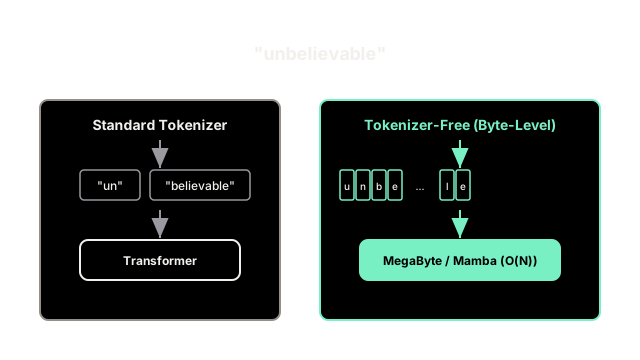
Almost every major LLM today uses sub-word tokenization (like BPE or SentencePiece). Tokenization takes raw text and arbitrarily chops it into chunks based on frequency. For example, "unbelievable" might become two tokens: ["un", "believable"].
This preprocessing step is a massive crutch that causes severe downstream problems:
- The Spelling Problem: LLMs cannot spell words or play Wordle because they literally cannot see the individual letters; they only see the chunky tokens.
- The Math Problem: If the number "345" is one token, but "346" is split into
["34", "6"], the model struggles to do arithmetic because the representation of numbers is wildly inconsistent. - The Multilingual Problem: Tokenizers are heavily biased toward English. A single Chinese character might be split into 3 meaningless byte-tokens, forcing the model to work 3 times as hard to process Chinese compared to English.
- The Coding Problem: Indentation spaces in Python might be grouped into weird tokens, making the model struggle with whitespace formatting.
Tokenizer-Free models (or Byte-Level models) throw away the tokenizer completely. They force the neural network to read raw text exactly as a computer does: one byte (or character) at a time.
Think of It Like This
Imagine trying to learn a foreign language, but someone pre-glued certain words together.
Instead of seeing the individual letters for "apple", you are handed a single block that says "apple". This is great for speed. But if someone asks you, "What is the third letter of apple?" you are completely helpless, because you don't have letters, you only have the "apple" block.
Tokenizers give LLMs these glued-together blocks. Tokenizer-free models force the LLM to read the individual letters, making reading slower, but granting perfect mastery over spelling, rhyming, and formatting.
How It Actually Works
The reason we use tokenizers is purely for computational efficiency. A Transformer's compute cost scales quadratically with the length of the sequence ().
If a paragraph is 100 tokens long, it might be 400 bytes long. If you pass 400 bytes into a standard Transformer, the math takes times longer to compute. Tokenizers compress the sequence length to make Transformers viable.
Tokenizer-Free architectures must solve this compute bottleneck.
1. MegaByte Architecture
Meta's MegaByte architecture solves this by splitting the Transformer into two pieces:
- A Global Model (large) that operates on patches of bytes (e.g., blocks of 8 bytes).
- A Local Model (small) that operates inside the patch, predicting one byte at a time. By separating the workload, it achieves the efficiency of tokenization without actually using a tokenizer.
2. State Space Models (Mamba)
Architectures like Mamba (State Space Models) do not use the Attention mechanism, meaning they scale linearly () rather than quadratically. Because the penalty for long sequences is so much lower, SSMs can ingest raw byte streams much more easily than Transformers, making them prime candidates for tokenizer-free AI.
Code
This snippet illustrates the difference in how the neural network receives the data.
# The string we want the model to processtext = "The AI is fast."
# --- The Standard Tokenizer Way ---# The tokenizer maps chunks of text to arbitrary integer IDstokens = tokenizer.encode(text) print(tokens) # Output: [464, 9552, 318, 3049, 13] # (The model has no idea 'AI' contains the letter 'A')
# --- The Tokenizer-Free (Byte-Level) Way ---# The text is converted directly to its raw UTF-8 byte valuesbytes = list(text.encode("utf-8"))print(bytes)# Output: [84, 104, 101, 32, 65, 73, 32, 105, 115, 32, 102, 97, 115, 116, 46]# (The model sees every individual character perfectly)Watch Out For
Context Window Exhaustion
Even with efficient architectures, byte-level models consume their context window 3 to 4 times faster than tokenized models. If your context window is 100k, a tokenized model can read a whole book. A tokenizer-free model might only be able to read a few chapters.
Training Time
Because the sequences are longer, training a byte-level model from scratch takes significantly more GPU hours than a tokenized model. This is the primary reason the industry still overwhelmingly uses tokenizers despite their obvious flaws.
The Quick Version
- Standard LLMs use tokenizers to compress text into chunks, which saves compute but destroys the model's ability to spell, do math, or process non-English languages efficiently.
- Tokenizer-Free (or Byte-Level) models feed raw characters/bytes directly into the neural network, solving all spelling and formatting issues.
- Because feeding raw bytes makes the sequence 4x longer, standard Transformers cannot handle them efficiently due to their scaling.
- New architectures like MegaByte or State Space Models (Mamba) are required to make tokenizer-free models computationally viable.