Voice Cloning and Consent
Because AI can instantly clone a human's voice from a 3-second recording, the industry had to develop cryptographic consent mechanisms and invisible audio watermarks to prevent deepfakes and fraud.
Why Does This Exist?
The invention of Zero-Shot Speech Synthesis (the ability to clone a voice perfectly from a 3-second audio clip) created an immediate and profound security crisis.
Within months of the technology becoming available, scammers were downloading 3-second clips of teenagers speaking on TikTok, cloning their voices, and calling their parents demanding ransom money for a fake kidnapping. Malicious actors cloned the voices of politicians to make fake robocalls telling people the wrong day to vote.
Unlike text or images, voice is deeply tied to human identity, trust, and biometric security (e.g., banking passwords). Because the AI models themselves cannot distinguish between a legitimate user cloning their own voice and a scammer cloning someone else's voice, AI companies had to engineer robust, cryptographic safeguarding systems directly into the audio pipelines.
Think of It Like This
The Invisible Ink
Imagine a machine that can perfectly counterfeit a handwritten signature just by looking at a tiny scrap of writing. To prevent mass fraud, the inventor builds two safeguards into the machine:
- The Consent Check: The machine refuses to operate unless the person whose signature is being copied walks up to the machine and speaks a specific, randomly generated passphrase.
- The Invisible Ink: Even when the machine does forge a signature, it uses a special chemical ink. To the naked eye, it looks like standard black pen. But under a blacklight, the word "FORGED" glows brightly, allowing banks to instantly identify it as a fake.
This is exactly how AI companies safeguard voice cloning.
How It Actually Works
Securing voice cloning involves a combination of pre-generation checks (consent) and post-generation tracking (watermarking).
1. Cryptographic Voice Consent
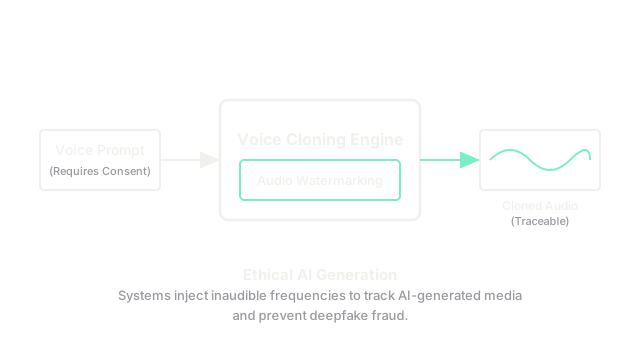
Before a commercial platform (like OpenAI's Voice Engine or ElevenLabs) allows you to clone a voice, you must prove you are that person. The system gives you a randomly generated sentence: "The purple elephant jumped over the three blue moons." You must record yourself saying that exact sentence. The AI then uses a Speaker Verification Model to compare the biometric acoustic fingerprint of your consent recording against the 3-second audio clip you want to clone. If the acoustic fingerprints don't match, the system rejects the clone. Because the sentence is randomly generated, scammers cannot just use an existing YouTube video of a celebrity to bypass the check.
2. Acoustic Watermarking
If the consent check passes and the AI generates the speech, we still need a way to prove that the resulting audio was generated by an AI, not a real human. The system applies an Acoustic Watermark. This is not a beep or a hiss that a human can hear. Instead, the AI slightly alters the amplitude of inaudible high frequencies in a specific mathematical pattern. If someone uploads that audio to a social media platform, the platform can run a quick mathematical check. If it detects the hidden frequency pattern, it can automatically flag the audio as "AI Generated," even if the scammer compressed the audio or added background noise to try and hide it.
3. Voice Actor Compensation Models
Beyond fraud, voice cloning created an economic crisis for voice actors. If an AI can clone a famous voice actor, why would a game studio pay the actor? To solve this ethically, platforms introduced revenue-sharing marketplaces. Voice actors explicitly consent to having their voices cloned and added to a public library. The actors retain cryptographic ownership of the voice model. Whenever a user generates text using that voice, the platform automatically tracks the server usage and pays a micro-royalty directly to the original voice actor.
Watch Out For
Open Source vs. Closed Source
The safeguards described above only work on closed-source APIs controlled by major companies. When powerful Voice Cloning models are released as Open Source (meaning anyone can download the weights and run them on their own computer), all consent checks and watermarking can be trivially removed by the user. This creates a severe ethical dilemma in the AI community: should voice cloning weights ever be released publicly, knowing they will inevitably be used for untraceable fraud?
The Quick Version
- Zero-Shot voice cloning allows anyone's voice to be perfectly replicated from a 3-second recording, creating massive risks for fraud, deepfakes, and identity theft.
- Commercial systems enforce Cryptographic Consent by requiring the user to read a randomly generated sentence, comparing their live biometric voiceprint against the voice they are trying to clone.
- Generated audio is protected by Acoustic Watermarking—invisible, inaudible frequency patterns injected into the sound wave that allow computers to mathematically prove the audio is fake.
- These safeguards are only effective on centralized APIs; open-source voice cloning models fundamentally cannot enforce consent, leading to ongoing debates about AI safety and open-source release policies.