Angles, Radians and Degrees
Degrees split a turn into 360 slices while radians measure the arc the angle cuts, so one convention suits people and the other suits calculus and code.
Why Does This Exist?
Angles arrive in two languages and they collide constantly. People say 90 degrees, but every math library computes in radians, and calculus formulas like the derivative of sine only work in radians. Every ML practitioner meets the seam: a rotation written in degrees silently fed to a radian function, producing garbage with no error message.
The fix is to see the two units as one idea with two rulers. Degrees chop a full turn into 360 historical slices. Radians ask how many radii of arc the angle cuts out, which makes them the native unit of circles, calculus, and code. This page teaches both and the conversion, so the handoff between human-readable and machine-computable never breaks. The parent topic is trigonometry.
The one idea you need first
A full turn is the angle that brings you back to facing the way you started. Call that amount 1 turn. Degrees define it as 360, radians define it as . Every conversion is just a fraction of a turn written in one ruler or the other.
Think of It Like This
A pizza cut two ways
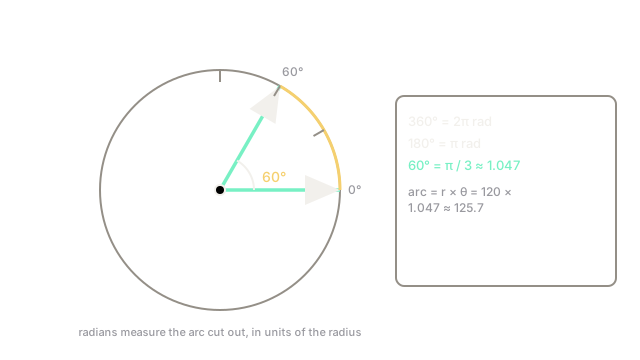
Imagine a pizza and two ways to describe a slice. Degrees are the party convention: cut the whole pizza into 360 slices and count them, so a quarter pizza is 90. Radians are the cook's convention: lay the crust's radius along the edge and count how many fit, so a quarter pizza is about 1.57 radii of crust.
Same slice, two counts. The party count is easy to picture, which is why humans use it. The cook's count connects directly to how much crust there is, which is why formulas prefer it. Neither is wrong; trouble only starts when you order in slices and the kitchen hears radii.
How It Actually Works
One full turn equals both rulers at once:
In plain words: degrees () count 360ths of a turn, radians (rad) count radii of arc, and (pi, about 3.1416) is the number of half-turns in the conversion. To convert, multiply by the fraction that cancels the old unit:
Radians earn their place with one formula degrees cannot match. An angle in radians on a circle of radius cuts an arc of length . No conversion constant, just multiplication. That is why arc lengths, angular speed, and every calculus result involving angles are stated in radians.
Worked example
Convert to radians and find the arc it cuts on a circle of radius 120:
Arc length: . Check against the full circle: circumference is , and one sixth of that (60 degrees is a sixth of a turn) is . Both routes agree, which confirms the conversion and the arc formula together.
Code
Convert once at the boundary and verify the arc two ways.
import numpy as np
theta = np.deg2rad(60) # degrees in, radians outprint(round(theta, 4)) # -> 1.0472print(round(120 * theta, 2)) # -> 125.66print(round(2 * np.pi * 120 / 6, 2)) # -> 125.66The arc from matches one sixth of the circumference, so the conversion is confirmed, not assumed.
Watch Out For
Mixing units inside one calculation
The classic wreckage: convert the input to radians but leave a threshold in degrees, or rotate by degrees then compare against a radian tolerance. Everything type-checks and every value is wrong.
Keep one unit per function and convert at the door. Name variables theta_rad or deg so the unit is visible, and treat any bare number near 3.14 or 57.3 (the degrees in one radian) as a unit-smell worth checking.
Assuming small-angle shortcuts work in degrees
The handy approximation for tiny angles is true only in radians. In degrees, , not 1, because one degree is only radians.
If a linearisation or a gradient step involving an angle behaves as if scaled by ~57x, a degree value slipped into a radian formula. Divide degrees by (that is ) before approximating.
The Quick Version
- Degrees split a turn into 360; radians count radii of arc, with a full turn equal to .
- Convert with going to radians and coming back.
- Arc length is simply when is in radians.
- 60 degrees is , about 1.047 radians; on radius 120 that cuts arc 125.66.
- Libraries and calculus expect radians, so convert at the boundary and name the unit.
- The small-angle shortcut holds in radians only.